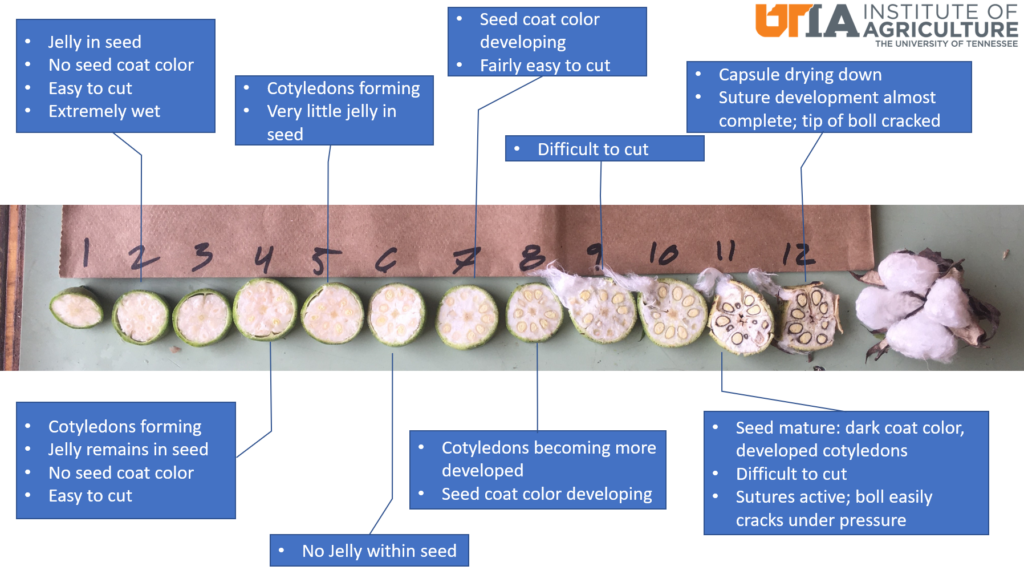
We are close to the end but a few still have acres left to defoliate. Others are considering applying another application to remove small amounts of leaf. Generally, most all of the harvestable bolls are open. Yields are off, in many areas considerably more than expected. At this point, we need to consider what we have in the field and what we might gain from another defoliation application. Most acres loosely break out to either 1,000+ lb per acre or far less than 1,000 lb per acre. The approach on these fields should generally be different. In this blog, I make a few comments and give a couple of examples of the best approach to wrap up 2025.
Category Archives: Cotton
New Midsouth Defoliation Guide available
Defoliating the 2025 crop just became more difficult. While you wait for your fields to dry, I’ve got a document that I believe may come in handy over the next few weeks. Each year, the MidSouth Cotton Specialists’ Working Group generate a defoliation guide. This document is a collaborative effort between Dr. Bradley Wilson (Missouri), Mr. Tyler Sandlin and Dr. Joshua Lee (Alabama), Dr. Brian Pieralisi (Mississippi), Dr. Shelly Kerns (Louisiana), and Dr. Zachary Treadway (Arkansas).
The 2025 document is just short of a complete rewrite and is worth your time to peruse. I’m particularly proud of the breakdown of the factors which influence plant response to product and rate along with the decision matrix and the streamlined program product selection guide. Special thanks to each of the authors for their time on this revision!
General thoughts on defoliation as conditions change
I’ve had a flurry of calls wondering what should change as we move into slightly cooler and *possibly* wetter conditions. I’ve also had several questions about why we’ve seen different responses to our concoctions this year than in years past. In this short blog, I list a few points to keep in mind. Continue reading
Fall is in the air and nematodes are in your soil!
Taking soil samples this fall? Why not send them for nematode screening? Take the test and beat the pest! Read on to learn how to take and submit soil samples – this fall get FREE screening of Soybean Cyst, Reniform, Root Knot, and Lesion nematodes and potentially SCN HG Type/Race testing (a >$150 value for free).
Two Tanks, One Goal: Smarter Weed Control Strategies
The use of precision agricultural technologies is rapidly advancing in row crop production. The latest of these technologies includes the introduction of ground sprayers that utilize AI technology for making targeted pesticide applications. The goal was to enable growers to reduce herbicide use while increasing crop production by precisely targeting weeds. Some questions have been raised about whether there are any additional benefits to this technology beyond reduced pesticide use.
Some of these sprayers are equipped with two separate tanks, each with its corresponding plumbing and boom. A single sprayer can utilize a dual boom system, where two pesticides can be sprayed simultaneously but not mixed. This allows a grower to make a broadcast application in one boom and use the targeted application boom to only turn on when a weed is detected. While you may see a decrease in pesticide use with the targeted application boom, you may also observe a beneficial effect when certain herbicides are sprayed separately, rather than being tank-mixed. Continue reading
Cotton Tour THIS WEDNESDAY at WTREC, starting at 8AM

The agenda has been set for the 2025 UT Cotton Tour 8AM THIS WEDNESDAY, Sept. 10 at the West Tennessee Research and Education Center (605 Airways Blvd, Jackson, TN 38305). Two private applicator points and four commercial points will be available (C01, C10, and C12). CCA points are also available. Cajun Express will be frying catfish for lunch. Agenda can be found by clicking here. Look forward to seeing each of you there!
One Big Beautiful Bill: NCC Meeting Sept. 11th 3PM @ WTREC, cotton specialist podcast
There has been uncertainty around the impacts of the One Big Beautiful Bill. I’m posting today to highlight a recent Cotton Specialists’ Corner podcast which covers this topic and let growers know about an upcoming meeting hosted by the National Cotton Council at the West Tennessee Research and Education Center (605 Airways Blvd Jackson, TN 38301). Information on the meeting hosted next Thursday, Sept. 11th at 3PM can be found by clicking here.
Two-Spotted Cotton Leafhopper (Cotton Jassid)
The Two-spotted cotton leafhopper or cotton jassid, has been making its way across the Southeastern cotton production areas with confirmed catches in Florida, Georgia, Alabama and South Carolina. Cotton jassids are small, sap-sucking insects that feed on the underside of leaves, causing “hopperburn”—a rapid yellowing, reddening, and browning that can quickly weaken plants. Native to Asia and first reported in Puerto Rico in 2023, this pest was confirmed in Florida in 2024 and has NOT been found in Tennessee fields in 2025. insecticide efficacy trials are underway, in affected states, to determine what insecticides are most efficacious and what the jassid’s impacts are on cotton yields.


The threshold at which treatment is recommended for the cotton jassid is one to two nymphs per leaf. To scout, we recommend looking on the underside of the main stem leaf on the third, fourth, or fifth node from the top of the plant. Again, the threshold is one to two nymphs per leaf with injury present anywhere in the field. This helps to confirm the correct insect ID, as other leaf hoppers will not cause these symptoms. Populations and symptoms usually begin on field edges before moving into the field.


For the 2025 Tennessee crop, I’m not overly concerned with cotton jassids. The vast majority of our fields have reached the finish line and are awaiting defoliation. We don’t need to add another insecticide expense to a crop that has struggled to be profitable since it was planted. That being said, if you suspect jassids are in your cotton please reach out to your county agent.