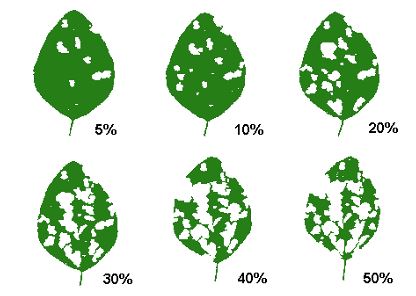
I’ve received several reports, over the last two days, on fall armyworms (FAW) infesting double cropped soybeans. Almost every one of these calls were incidents of grass escapes and the lone exception was FAW migrating from a grass turn-row into v-stage beans. Somethings to keep in mind, vegetative soybeans can withstand 30% defoliation before yield loss and reproductive stage soybeans can withstand 20% defoliation before yield loss. Below is guide to help gauge defoliation levels.
Visual Guide to Soybean Defoliation
If you do see armyworms it shouldn’t be automatically assumed that pyrethroids won’t be effective. We don’t fully understand why pyrethroids provided inconsistent control in 2021. Resistance is a possibility but overlapping generations causing mixing of various worm sizes resulting the appearance of poor control is another possibility. Also, since armyworms don’t overwinter in Tennessee and there is no evidence of reverse migration, the armyworms we experienced in 2021 won’t be the same ones we see in subsequent years. However, if pyrethroids do fail to control armyworms please contact your local county agent.
The FAW we are currently facing are the rice/grass strain, not the corn strain. They are impossible to distinguish visually but they are very host specific. Grass strain FAW almost always colonize grass, not soybeans, corn or cotton. Corn strain FAW almost always infest corn, soybeans or cotton not grass or rice. Another key difference is grass strain FAW are typically very susceptible to pyrethroids while corn strain are resistant. What happens when grass escapes occur in soybeans is the grass is controlled and FAW are forced off of a dying host on to soybeans. They don’t necessarily want to eat the soybeans but have no other options. If you have FAW in your fields and haven’t controlled grass yet, adding a pyrethroid would be a prudent step to save another potential trip. If you want other options outside of pyrethroids or are concerned they won’t work that list is here:
Acephate: 0.75 lb ai/ac,
Diamond: 6.0 fl oz/a,
Intrepid 4.0 fl oz/a,
Intrepid Edge 4.0 fl oz/a,
Vantacor 1.2 fl oz/a,
Elevest 5.6 fl oz/a,
Besiege 7.0 fl oz/a
Don’t automatically reach for the diamides (Vantacor, Elevest, Besiege) these products provide excellent FAW control but are costly. All of the above products will provide satisfactory control of FAW in soybeans.
Tarnished plant bug numbers seem to be all over the board in 2024. Some fields have one spray since square set and others have had upwards of five. Crop age and what’s neighboring your cotton play a large part of how intense plant bug pressure is over time. That being said, keeping an eye on square retention is the best gauge to determine how well your insecticides are performing. Most I’ve talked to have applied Diamond at least once since first bloom. Diamond shines when you catch early plant bug hatches often after large adult migrations during late squaring and we see a good ROI with Diamond around that 1st week of bloom timing.
Going into bloom, I don’t think neonics have a fit in any scenario. Every time we test a neonic sprayed after bloom its often one of, if not, the worst treatments in the test. Once you see a flower migrate to the Transform, Acephate, Bidrin treatments. Pyrethroids can be added in with OP’s to help increase control and acephate + pyrethroid can catch a few bollworms in the top of the canopy if you’re close to cut out (although our 3 gene cottons are doing a great job of controlling bollworms). Diamond should rotated around in the bloom mix also. Overlapping Diamond residual, usually spaced out every other shot, can help reinforce control of nymphs. I don’t like Diamond fb Diamond in succession. Diamond’s effects may take 7 to even 10 days to notice and sequential shots may not take full advantage of the residual it provides, but that’s situation dependent.
Thryvon bloom performance is on par with what we’re accustomed to seeing. Square retention is often better in Thryvon and plant bug numbers, especially nymphs, are lower. Insecticides seem to perform better in Thryvon for a couple of reasons. Less insects are typically easier to control, plant bug population growth is slower and we think the nymphs don’t settle in bracts/blooms like they do in non-Thryvon. Nymphs are constantly moving in Thryvon and the more they move, the higher likelihood they’ll encounter an insecticide. Final note, Thryvon has minimal, if any, activity on stink bugs and if you’ve gotten by without using a broad-spectrum insecticide mid to late bloom, I would add an OP or pyrethroid to clean up any building/lingering populations.
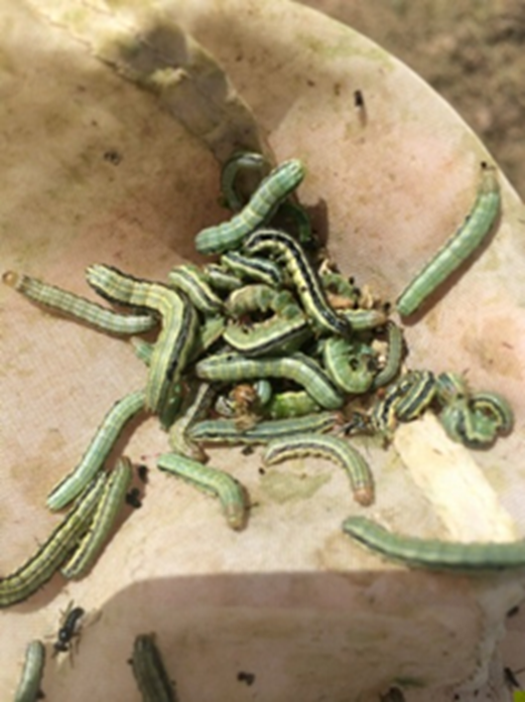
Over the past couple days, I’ve gotten a few reports of fall armyworms in pastures on the Mississippi/Alabama border with Tennessee. Tennessee will still have armyworms that migrate North and infest pastures, food plots and the occasional yard every year. However, the situation that happened in 2021 was a very unique event and will not occur yearly. That being said, reports of armyworms in 2024 are roughly two weeks earlier than what we typically see.
Fall Armyworms in a Sweep Net
Fall armyworms don’t overwinter in Tennessee and populations migrate North from Texas and Florida every year. The difference in 2021 vs 2023-24 is the conditions that were occurring in April and May in South Texas. Texas experienced a warm and unseasonably wet spring that allowed for the proliferation of extremely large numbers of armyworms. Large numbers of moths plus ample food supply in pasture grasses, fallow grasses, yards and pretty much anywhere that had grass allowed this “army” to make its way North. Texas experienced outbreaks first followed by Louisiana, Arkansas, Mississippi then Tennessee with the moth flight culminating, in Canada, in November. I ask my colleagues, in Southern states, weekly if they are seeing any armyworms or anything resembling what happened in 2021 and the answer has consistently been no. My colleagues in Arkansas are getting calls about armyworms in rice and pastures but nothing even close to what was experienced in 2021.
If you do see armyworms it shouldn’t be automatically assumed that pyrethroids won’t be effective. We don’t fully understand why pyrethroids provided inconsistent control in 2021. Resistance is a possibility but overlapping generations causing mixing of various worm sizes resulting the appearance of poor control is another possibility. Also, since armyworms don’t overwinter in Tennessee and there is no evidence of reverse migration, the armyworms we experienced in 2021 won’t be the same ones we see in subsequent years. However, if pyrethroids do fail to control armyworms please contact your local county agent.
Going forward, pasture treatments should be considered when armyworm populations exceed 3 to 4 worms per square foot. If fields are ready or near ready for cutting, harvesting is suggested rather than applying an insecticide. Producers may watch for the presence of birds in a field as an indicator of armyworms. This method should not be the only one used to check for armyworms because this indication often is too late to avoid field injury. Early signs of infestations by small larvae cause plants to have a “window-paned” appearance. This is due to the larvae’s inability, at small sizes, to chew completely through the leaf blade leaving the upper epidermis intact. Large areas of window panning will give fields a frosted appearance. Ideally, scouting should be initiated in late July to early August without the presence of birds or frosted patches appearing so infestations can be caught early. When scouting during times when armyworms are not feeding (midday) be sure to dig through the thatch layer and check the base of plants. Detection of frass (insect excrement) is also a sign that armyworms may be present in a field.
Information on grazing restrictions, application rates and insecticide choice can be found below.
The take home is scout early and often for armyworms in pastures, hayfields and turf areas. It may be prudent to initiate scouting earlier than we’re accustomed to catch any early infestations that may slip by.
UT’s Soybean Scout Schools will be held in July (see details below). These field-side programs cover the basics of soybean growth, scouting, pest identification, and general management. Pesticide recertification and CCA CEU points will be available. Scout Schools are offered free of charge with sponsorship from the Tennessee Soybean Promotion Board. Registration is not required. Participants will receive a scouting notebook and a sweep net while supplies last.
West TN – Madison County, July 15th, 9:00 AM – 11:30 AM. This school will be at the West TN Research and Education Center, 605 Airways Blvd. Jackson TN, 38301. Signs will be up at the station to direct you to the field.
2024 Franklin County Soybean Scout School
Middle TN – Franklin County, July 16th, 9:00 AM – 12:00 PM. This school will be at 601 Cumberland St., Cowan TN 37318. Contact Matthew Deist for more information. 931-967-2741, mdeist@utk.edu. Register online at https://tiny.utk.edu/SoybeanScoutSchool
West TN– Obion County, July 17th, 9:00 AM – 11:30 AM. This school will be held at the Obion Farmers Coop, 810 Mt. Zion Rd Union City, TN 38261. Contact Garrett McDaniel for more information gartmcda@utk.edu, 731-223-1178.
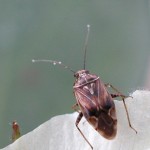
I’ve received a few calls on adult tarnished plant bug migration into squaring cotton. Silking corn, blooming soybeans and flowering pigweed all contribute to large increases in plant bug numbers that make their way to ThryvOn and non-ThryvOn cotton. ThryvOn’s bt gene can help reduce the amount of injury plant bugs inflict to squaring cotton but adults, especially large numbers of adults, can knock squares off of ThryvOn just like non-ThryvOn. I’ve seen ThryvOn cotton go from 90 plus percent square retention to sub 50 percent in 5 days due a large, consistent migration of adult plant bugs. The biggest benefit we see from ThryvOn is the reduction of plant bug immatures in bloom. That being said, you will typically see increased square retention in ThryvOn vs non-ThryvOn throughout the fruiting period. Scout your cotton and don’t ignore migrating plant bugs in ThryvOn or non-ThryvOn. Also, many of the newer varieties begin squaring on the 5th or 6th node and we need to quickly transition from scouting for thrips to plant bugs.
TPB Adult
Based on field reports, 2.0 oz/a of Centric is performing well on plant bug populations. Although the same class of chemistry, imidacloprid’s performance is fair at best and recolonization often happens quickly after an imidacloprid application. I try to not recommend consecutive applications of neonics due to efficacy falling off after the first shot. However, consecutive shots of neonics may be warranted for several reasons (cost, presence of mites, personal choice etc.) and on the second application I tend to increase rates of Centric to 2.5 oz/a especially if it was used previously. After the second application we’ve pretty much exhausted that chemistry. Other options are: acephate which carries a high risk of flaring mites and aphids especially in our current dry period, Vydate which is effective in killing plant bugs but has limited residual, roughly 36 hours, Bidrin isn’t labelled for plant bugs between first square and bloom, Transform, which is very effective, but is expensive and many want to save those shots for bloom unless aphids are present and Diamond. Diamond’s activity is best utilized in the 3rd week of squaring to first bloom window, several studies at MSU and UT have shown the best ROI of 6.0 fl oz/a Diamond during that time period.
Final note, I’ve received a few questions on squaring cotton having poor square retention but very few or no plant bugs are found scouting. Adult plant bugs, especially at this time of year, will move in and out of cotton quickly. The abundance of alternative hosts facilitates movement in and out of cotton without colonization. The take home is since most are scouting once a week, it is prudent to be more aggressive with applications and not risk square retention falling below 80% if you’re close. Monitoring square retention is one of, if not, the best way to determine if early-season treatments are working. Migrating adults can give the impression of an insecticide failure, but maintaining good square retention is a good indication that treatments are working.