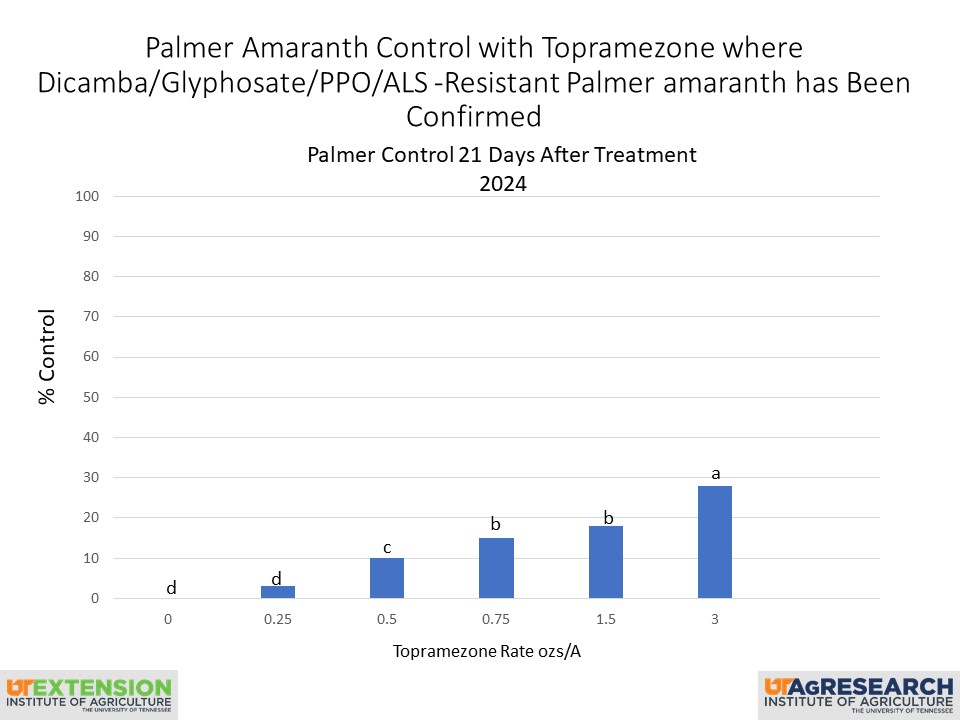
Last fall there was a notable amount of Palmer amaranth in many corn fields in areas of the state where we had confirmed dicamba resistance. As a result, we have recently conducted some field screens on these pigweed populations to herbicides used in corn and soybean.
From late April and throughout the month of May, many parts of Middle and West TN have received persistent rainfall that is well above the average for this period. These rains have produced persistently wet soil conditions and have coincided with sidedress N fertilizer application where most or all of the recommended N is applied. With this much rain, there is potential for N loss. Continue reading →
Carryover injury from fomesafen (Flexstar, Prefix, Reflex, Intimidator, Marvel, Dawn, Rhythm, etc.) is starting to show in a few corn fields. This is because some applications in late June and July in 2023 coupled with a very dry fall allowed the herbicide to persist into winter. Recent rains then allow any herbicide carryover to more completely get into the soil solution.
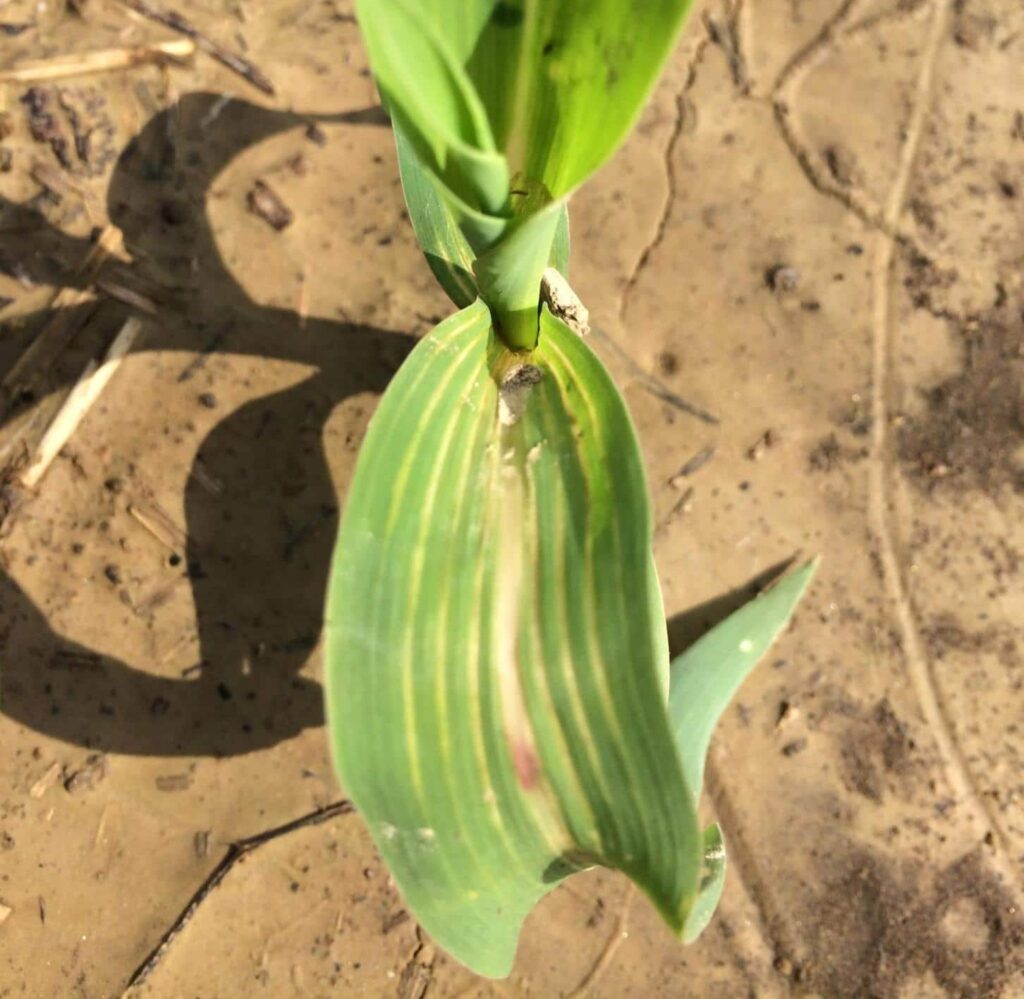
Fomesafen carryover injury in corn and grain sorghum looks similar. Expect to see stunting and interveinal chlorosis as pictures below sent from crop consultants clearly shows.
Striping of corn leaf veins characteristic of fomesafen carryover
Due to little time and very few good spray days, some corn fields have yet to have their layby application. Corn is putting on a new leaf every 3 days with all the heat and water. Therefore, time is short before it will be too mature to apply many herbicides safely over the top.
How large can corn be before glyphosate could potentially cause injury? The glyphosate label states it can be applied up through the V8 corn growth stage. My experience has been if glyphosate is applied to corn larger than that it can at times cause ears to be barren. This phenomenon is difficult to predict ahead of time as it can vary due to maturity of the corn at application, hybrid and weather.
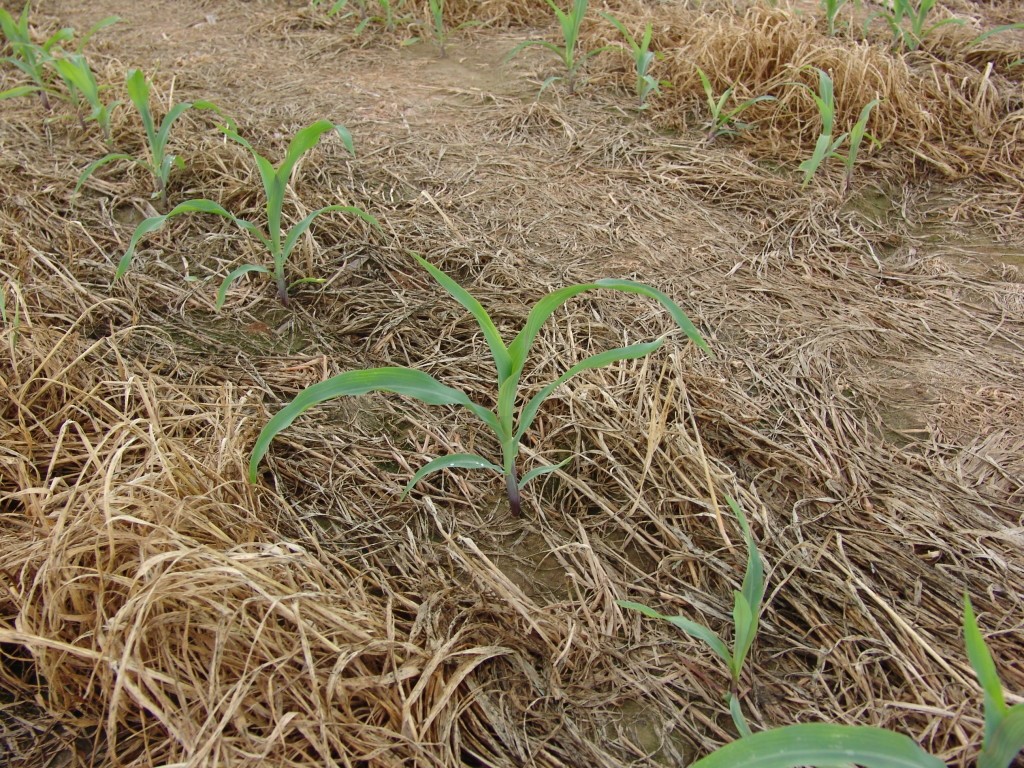
Crop stage and/or crop height is used to determine the cutoffs for a given herbicide. Often the label states the limits at whichever (crop stage or crop height) comes first. Crop stage can easily be done by counting the number of leaf collars that are fully exposed (Ex: 4 collars = 4 leaf) (Picture below). If tankmixing, cutoff is always determined by the most limiting factor.
4 – Leaf Corn
Johnsongrass Escaping Glyphosate Burndown
Postemergence Corn Herbicides
Crop Height Cutoff
Crop Stage Cutoff
Accent
20 inches
6 leaf
Acuron GT
30 inches
8 leaf
Atrazine (Bicep, Degree Xtra, Acuron, etc.)
12 inches
–
Callisto*
30 inches (without atrazine)
–
Capreno*
20 inches
7 leaf (without atrazine)
Corvus
2 leaf
–
Dicamba (Clarity, etc.)
8 inches (1 pt/A) or
36 inches (1/2 pt/A)
5 leaf
–
Distinct
24 inches
–
Glyphosate – RR corn only
30 inches
8 leaf
Halex GT
30 inches
8 leaf
Armezon/Impact
–
8 leaf
Laudis
–
8 leaf
Liberty – LL corn only
24 inches
7 leaf
Diflexx
36 inches
10 leaf
Realm Q
20 inches
7 leaf
Resicore
11 inches
–
Resolve Q
20 inches
7 leaf
Roundup PM – RR corn only
–
8 leaf
Shield Ex
20 inches
6 leaf
Status
36 inches
10 leaf
Steadfast Q
20 inches
7 leaf
Storen
–
8 leaf
2,4-D
8 inches
–
*Note that if atrazine is added to herbicides such as Callisto or Capreno for example, the cutoff would be reduced to 12 inches.
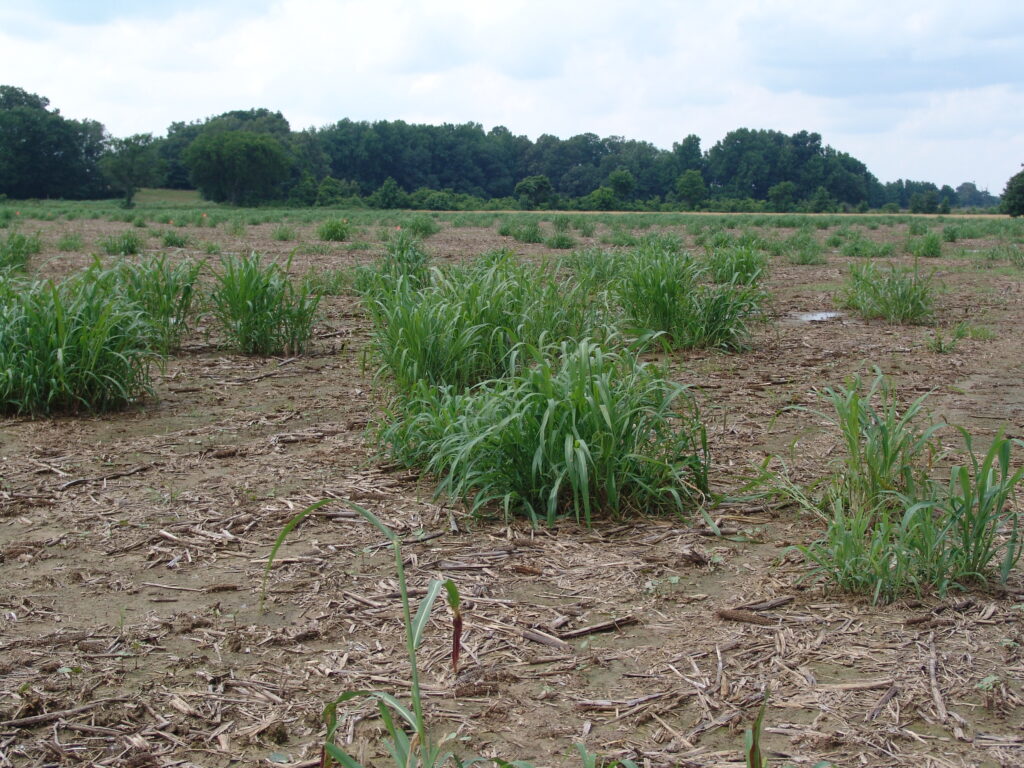
Large patches of Johnsongrass that have gotten through glyphosate burndown are now very prevalent in many fields. This is particularly noticeable in several southeastern counties of West Tennessee where some of the Johnsongrass has shaken off burndown and now is almost waist high in some cases. The main threat with Johnsongrass is in corn where there are few POST applied options. Continue reading →
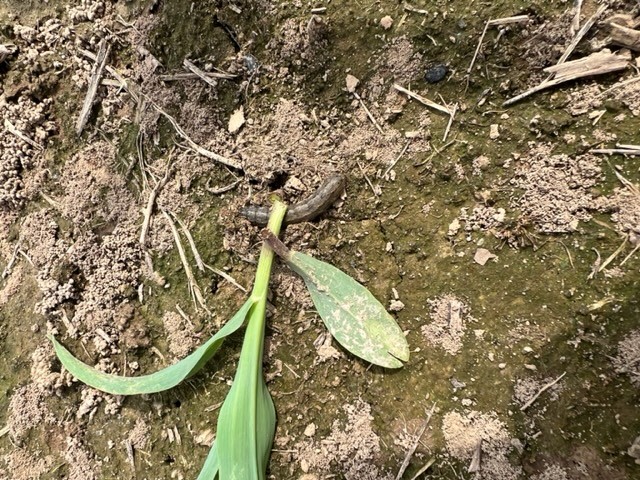
I’ve received a few calls in the past couple days on cutworms appearing in seedling corn. Below are some take home points on cutworms:
Cutworm in Corn
You probably do not need to worry about cutworms if you have kept a weed free seed bed for 2-3 weeks prior to planting, and this is especially true if using some of the Bt corn technologies (see below). However, the weather this year has not generally allowed for burndown applications made 3-4 weeks before planting.
Consider making an insecticide application near planting time. Relatively low rates of pyrethroid insecticides are typically effective for cutworm control. I do not recommend including an insecticide with herbicide applications that are made more than a couple weeks in advance of planting. Tank mixing an insecticide with an early burndown application may not be that effective. Cutworms you kill would have probably ‘cycled out’ before you planted. And because you cannot expect much residual control, there is the possibility of re-infestation between application and planting. The best time to make this application is within a few days before or after planting.
Using Capture LFR or other in-furrow pyrethroid insecticide as an in-furrow spray can add some protection against insect pests not completely controlled by seed treatments (e.g., cutworms and sugarcane beetles). I would prefer a T-banded type application where some of the product is applied to the “shoulders” of the seed furrow. This should improve control of cutworms compared with an application where 100% of the product is applied in-furrow. However, in-furrow applications appear to provide adequate control of cutworms in most circumstances.
No insecticide seed treatments should be expected to provide substantial control of cutworms. However, I have seen Poncho 1250 kill small cutworms in the past, don’t bet the farm on this though. Some Pioneer corn seed now includes a base treatment of Lumivia (chlorantraniliprole). This product should provide at least some control cutworm, but data is limited.
Although Bt corn and cotton traits provide some protection against cutworms, planting into fields that are heavily infested can be risky. Bt corn traits such as Leptra, VT2 Pro, SmartStax, Viptera, ad nTrecepta corn can reduce cutworm injury. Vip corn (Leptra, Trecepta, Viptera) will provide the best protection from a Bt stand point. However, large larvae are much less susceptible to Bt toxins.
By Nutifafa Adotey, Assistant Professor & Soil and Nutr. Magt Specialist, Forbes R Walker, Professor & Envt. Soil Specialist, and Frank Yin, Professor & Cropping System Scientist, University of Tennessee
Poultry litter has become readily available to producers in Tennessee. However, poultry litter cannot supply all the nitrogen needed for corn and thus supplemental N is required to obtain optimal yield. The amount of supplemental N can be estimated using the Pre-Sidedress Nitrate Test. The Pre-Sidedress Nitrate Test is recommended only for corn producers using animal manure, poultry litter or biosolids, who want to estimate and fine-tune their sidedress N fertilizer applications following manure/poultry litter application. This article provides a guide for Tennessee corn producers using poultry litter on how to estimate sidedress N rate using the Pre-Sidedress Nitrate Test. Continue reading →