Results from the 2022 TN soybean variety trials are now available as pdf and excel files and will be posted at search.utcrops.com/soybean. Seventy-five varieties were evaluated in small plot replicated trials (REC) at nine locations and fifty-seven varieties were evaluated in three to nine locations as non-replicated large strip plots (CST). Quality and agronomic traits are reported for the REC trials and disease data are reported for CST trials. A summary of varieties that were in the yield “A group” (not statistically different from the top yield within each test) in either the REC or CST trial can be viewed here 2022 Soybean A Table.
Recent Updates
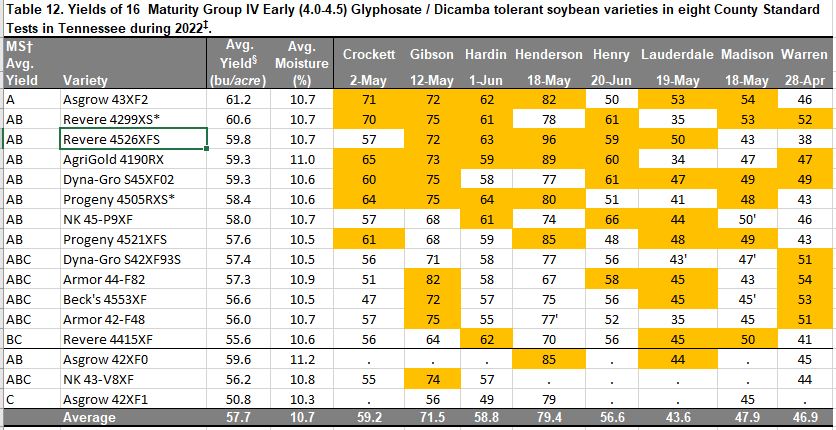
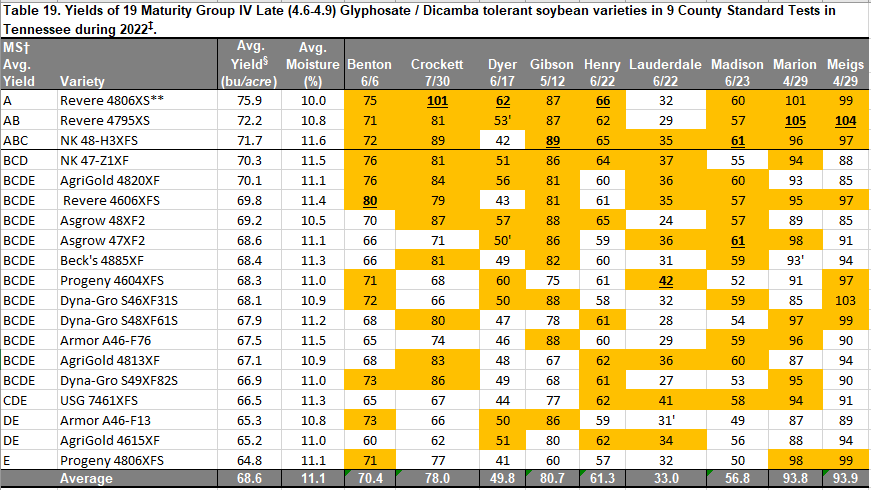
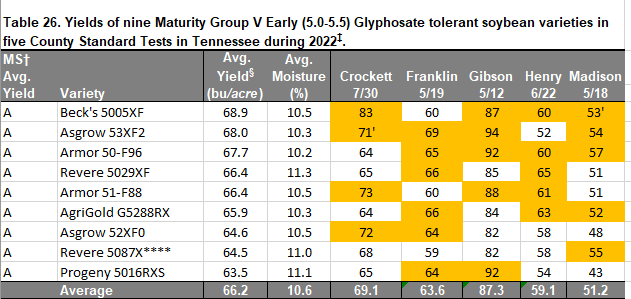
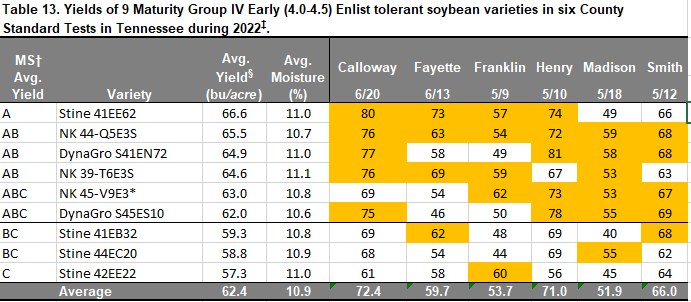
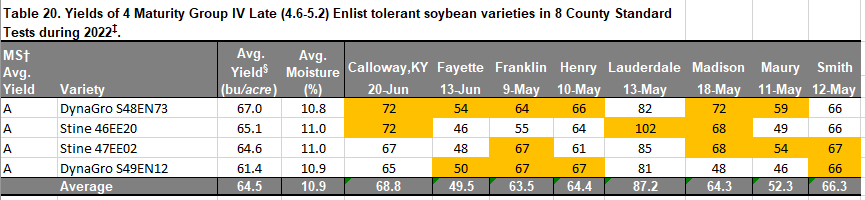
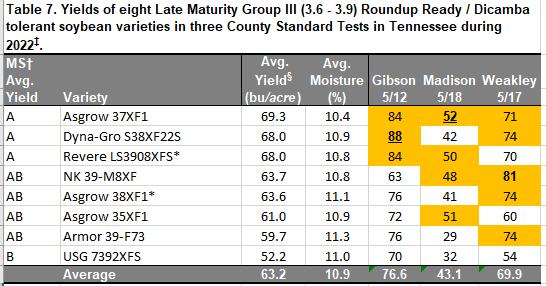
Soybean Yield Data-’22 County Standardized Trials
As harvest comes to a close for the season, it’s time to make variety selections for the 2023 crop. In 2022, the CST program tested 65 varieties at 39 locations across Tennessee. Our soybean trials are split up by maturity group and herbicide tolerance. For Xtend Flex varieties, we have a late group 3, early group 4, late group 4, and an early group 5. For our Enlist varieties, we have a early group 4 and a late group 4 test.
These tables should be used to assist you in selecting high yielding varieties. UT recommendations are based on non-bias, statistically backed data collected from our on-farm variety trials (CST’s) along with our Official Varity Trials (OVT’s) conducted on our Research and Education Centers across the state. Varieties in the ‘A’ group are recommended by UT. If a variety has an * or multiple *’s, that variety has been in the ‘A’ group for consecutive years. An orange cell indicates that variety is at or above the location’s average yield.
All of this data will be published on https://search.utcrops.com/ as well as covered in county productions meetings this winter. If you need a hard copy of this data, please contact your local County Extension Office.
Thanks to all the Agents, growers, and industry for your support and cooperation in making this program possible.
Click on the tables below to enlarge.
Metribuzin Injury in Wheat

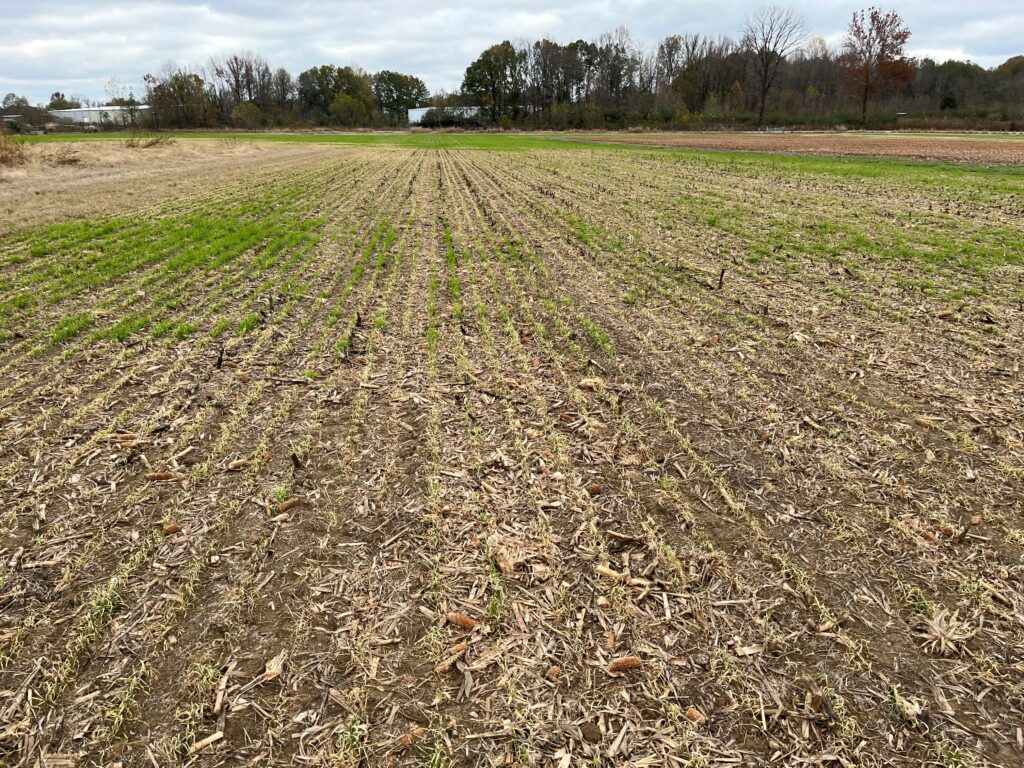
We have gotten several reports of wheat showing metribuzin injury this week. In some cases it clearly was caused by metribuzin (Picture 1). In other cases, the visual injury would suggest frost damage (Picture 2). Continue reading
2022 Corn Grain Hybrid Tests in TN – Now Available
Results from the 2022 TN corn grain hybrid trials are now available as both pdf and excel files. Sixty hybrids were evaluated in small plot replicated trials (REC) at eight locations and fifty-one hybrids were evaluated as non-replicated large strip plots (CST) in thirteen to seventeen locations. A summary of hybrids that were in the “A group” (not statistically different from the top yield within each test) in either the REC or CST trial can be found here – 2022 corn A table.
County Standardized Trials Corn Data
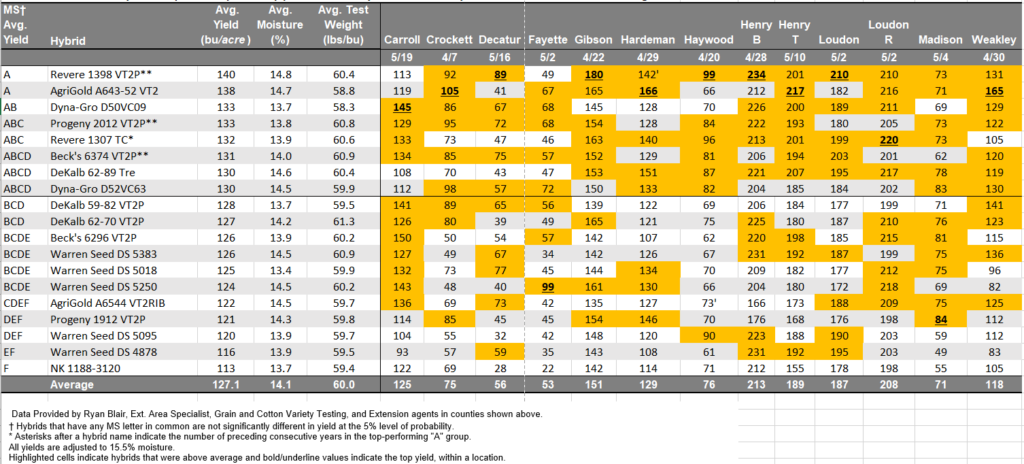
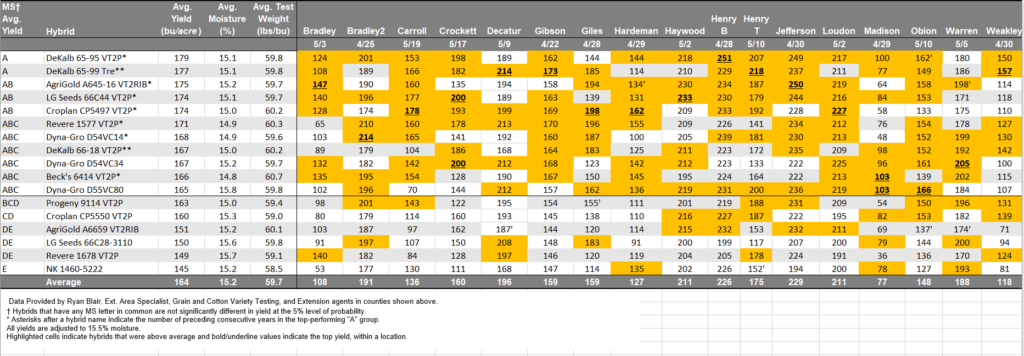
Yield data from our County Standardized Corn Trials are in. With extended drought and heat, much of our corn was stressed and decreased yields were common. While we did experienced areas of low yields, having a high number of locations serving as replications allows for a high confidence level statistically.
These CST plots are large strip trials located ‘on-farm’ with a minimum of 300 feet in length. Inputs and management decisions are on a by location basis and determined by the cooperating producers. Three relative maturity groups divide the trials, Early Corn will be 113 day and earlier, Medium Corn will be 114-116 day, and Full Corn is 117 day plus.
Below are the results for our 3 RM groups. Click on the table to open a PDF of these tables. These results can also be accessed on https://search.utcrops.com/ 
Thank you to everyone involved in making this program happen. It wouldn’t be possible without all the County Agents, Cooperating Producers, Seed Industry Representatives, and others involved.
What to expect as temps drop into the 30s, boll opening and boll maturity hereon
Conversations this week have centered on the forecast lows over the coming weekend, boll maturation at temperatures averaging below 60F, and slow activity of defoliants and boll openers. In this blog, I briefly tackle each of these issues. Continue reading
New Regulation on Atrazine Public Comment Period Closes October 7.
The Environmental Protection Agency (EPA) has proposed additional mitigations and regulations on the use of atrazine. The open comment period will close this Friday October 7. If you are interested in commenting see this link. I know that it is a very busy time of year but please consider making a comment on this topic. You all are the experts since you steward this herbicide, on many acres, each spring and your comments have more value than many that are sent. Continue reading