 Below please find a link to the recorded zoom training for the 2020 UT Cotton Scout School. It is a rather lengthy training, but you can fast forward and rewind at your discretion.
http://www.utcrops.com/BlogStuff/2020-UT_CottonScoutSchool.mp4


Below please find a link to the recorded zoom training for the 2020 UT Cotton Scout School. It is a rather lengthy training, but you can fast forward and rewind at your discretion.
http://www.utcrops.com/BlogStuff/2020-UT_CottonScoutSchool.mp4
Posted for Dr. Aaron Smith, Associate Professor and Extension Economist, Department of Agricultural and Resource Economics, University of Tennessee Institute of Agriculture
The USDA has started accepting applications for CFAP payments to producers that have been adversely affected by the COVID-19 pandemic. Continue reading

Because of the COVID-19 situation, the 2020 UT Cotton Scout School will be held by webinar (via Zoom) on May 29th, beginning at 8:30 AM and ending by Noon. Participants will be required to preregister to receive the Zoom password to enter the meeting. To preregister, please email LaDonn Kelso at dkelso2@utk.edu. She will reply to your message with the Zoom meeting password.
Pesticide re-certification points and Continue reading
This week will be the start of the early POST applications in cotton. These applications are often critical to not only curtail weed competition but to combat thrips injury as well. The biggest concern with these applications is injury to the young cotton plants. Continue reading
Christopher N. Boyer, Tyson B. Raper, and S. Aaron Smith
May 20th (Final Planting date) has come and gone and June 4th (End of Late Planting) is around the corner for cotton producers. If you haven’t planted yet and have Revenue Protection or Yield Protection insurance policies, there are four options:
In this report, we examine each of these alternatives by assessing the profit-maximizing option using historical crop yield data, and also lay out information producers should consider if they are faced with a prevented planting decision. Continue reading
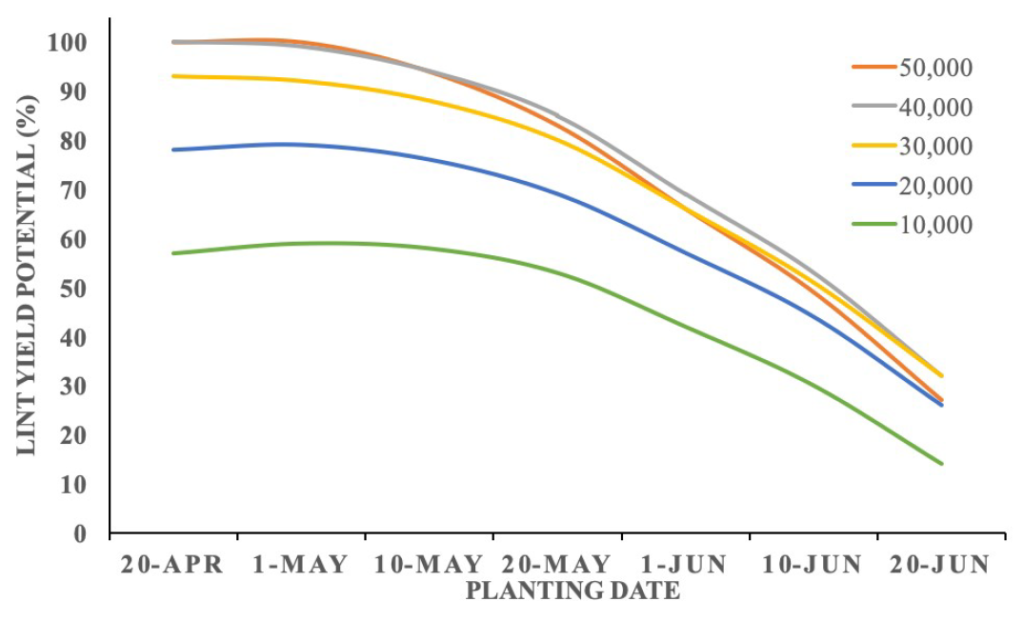
With the majority of our cotton acreage yet to be planted, many have asked how late should I plant? To answer that question, you must estimate current lint yield potential. Dr. Shawn Butler, who recently finished his PhD in the UT Cotton Agronomy Program, compiled data from 10 field trials in Tennessee, Mississippi and Missouri to assist those interested in estimating lint yield potential based on planting date and plant population (not seeding rate, but actual plants emerged per acre). The figure above was generated with that data.
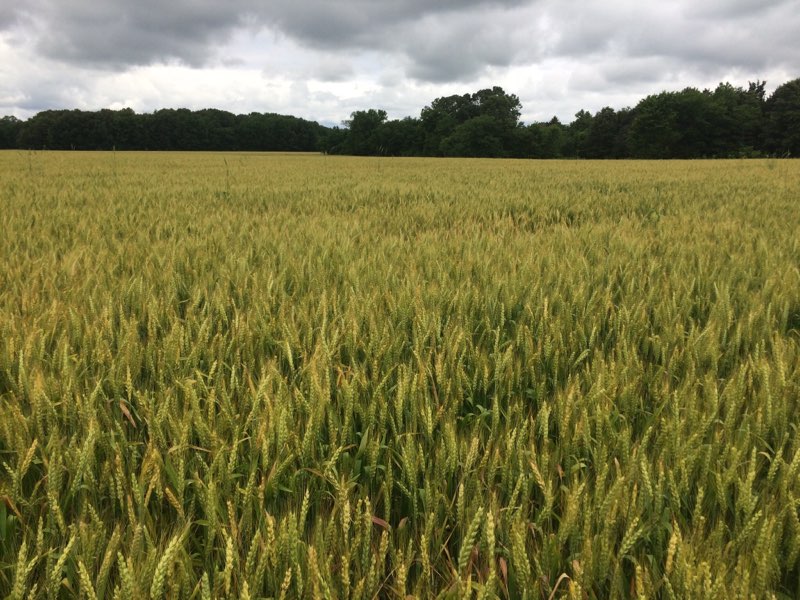 Reports of blanks in wheat heads began trickling in last week and by this week became common. The impacted areas appear to run northeast from Hardeman/Fayette Counties through Madison county and into Henry County. The injury I’ve observed has ranged from light to severe, with the worst injury appearing on acres that were planted in early October. From the windshield, the injury will likely not be noticeable; at a distance, the wheat may simply appear to be maturing rapidly (see image above). Estimated yield loss from the picture above equaled 40%. Continue reading

A reminder that moth trapping data are updated weekly at http://www.utcrops.com/BlogStuff/2020MothTrappingData.pdf, and you can also access these data on the Quick Links of this site. Pheromone-baited traps are run for corn earworm (bollworm), tobacco budworm, and southwestern corn borer.
Currently, moth trap catches are generally low, as typically observed this time of year.