All posts by Larry Steckel, Extension Weed Specialist

2021 Cotton Focus Video Series: Grass Management by Dr. Larry Steckel, Clay Perkins

Two men in field, wearing blue shirts and hats.Our second series of presentations for the 2021 Cotton Focus Video Series are from Dr. Larry Steckel’s program.  Dr. Steckel and his PhD student, Clay Perkins, will be presenting  two topics for us- the first is ‘Grass Management in Xtend and Enlist Cotton’ and the second is ‘Characterization and Management of Glyphosate-Resistant Junglerice’.  We are extremely blessed to have Dr. Steckel in Tennessee and I’m excited to have these two very important topics covered, especially after the challenges we’ve faced with grasses in recent years.

You can find links to Dr. Steckel’s and Mr. Perkins’ presentations below.


Soybean Herbicide Trait Summary

Herbicide resistant traits available in soybean continue to increase.  It does not seem that long ago that there was either Roundup Ready or conventional soybean.  There are no less than eight different soybean herbicide resistant traits available today with the most recent being XtendFlex soybean.  Continue reading →


New Dicamba Labels Mandate Adding Volatility Reducing Agent

Author: and  Comments Off on New Dicamba Labels Mandate Adding Volatility Reducing Agent

As most know the EPA approved a new five-year registration for Engenia, Tavium and XtendiMax to be used in Xtend cotton and soybean. The new registration has some new labeled directions on application of these herbicides. In a series of articles this winter, we will try to highlight the major label changes.

One of the new labeled requirements for these three herbicides is the addition of a volatility reducing agent (VRA). Continue reading →


Managing Weeds in Wheat

Author:  Comments Off on Managing Weeds in Wheat

As we approach the fly-free date for sowing winter wheat, we need a plan to control our most common weedy pests in this crop.  The two most common weeds in our wheat every year are poa and ryegrass.  The fall is the best time to control these two weeds in wheat. Continue reading →


Good Time to Scout for Weeds

Author:  Comments Off on Good Time to Scout for Weeds
Dense overgrown field with lush green plants.
Pigweed that has escaped dicamba + S-metolachlor + glyphosate on 4 to 6″ weeds followed 20 days later with dicamba + S-metolchlor + glyphosate: Montgomery County, TN. Sept 1, 2020

Some have been concerned about losing dicamba due to court or EPA rulings. Everyone should be more concerned about losing dicamba and 2,4-D to Charles Darwin’s theory. Weeds developing herbicide resistance has caused the loss of many more herbicides than anything a court or the EPA has ever done. It’s not even a close race.

This is particularly true for Palmer amaranth. The newest development is that Palmer amaranth has evolved dicamba resistance here in Tennessee. We are in the beginning stages of Palmer amaranth, yet again, becoming a major problem due to the loss of a herbicides’ utility on that weed. Continue reading →


Dicamba-Resistant Palmer Amaranth in Tennessee: Stewardship Even More Important

Author:  Comments Off on Dicamba-Resistant Palmer Amaranth in Tennessee: Stewardship Even More Important
Lush green field with distant trees under blue sky.
Picture 1. Palmer amaranth escapes after a dicamba + glyphosate application in a Gibson County cotton field.

Has Palmer amaranth evolved dicamba resistance in Tennessee?  Results from some of the greenhouse experiments this winter and spring as well as in field research this growing season would suggest that our state now has dicamba-resistant (DR) Palmer amaranth. These DR populations are established in Crockett, Gibson, Madison, Shelby, and Warren counties and likely several others. Continue reading →


Strategies to Address Palmer amaranth, junglerice and goosegrass Escapes from Follow-up Applications in Xtend and Enlist Crops.

Field of young plants under a cloudy sky
Carpet of Palmer amaranth escapes from a 0.5 lbs of dicamba + 32 ozs glyphosate + S-metolachlor: Pic taken 20 DAA: S-metolachlor was only herbicide that looked to be working in this field.

Calls continue from some folks frustrated with goosegrass, junglerice and Palmer amaranth escapes after a dicamba + glyphosate application. A large reason for the frustration is the follow-up applications have often provided less control than hoped. Timing is the cause for some of these poor weed control issues. Herbicide resistance is another cause. Continue reading →


Concerns About Poor Palmer Amaranth Control with Dicamba

Dry field with wilted plants under bright sun.
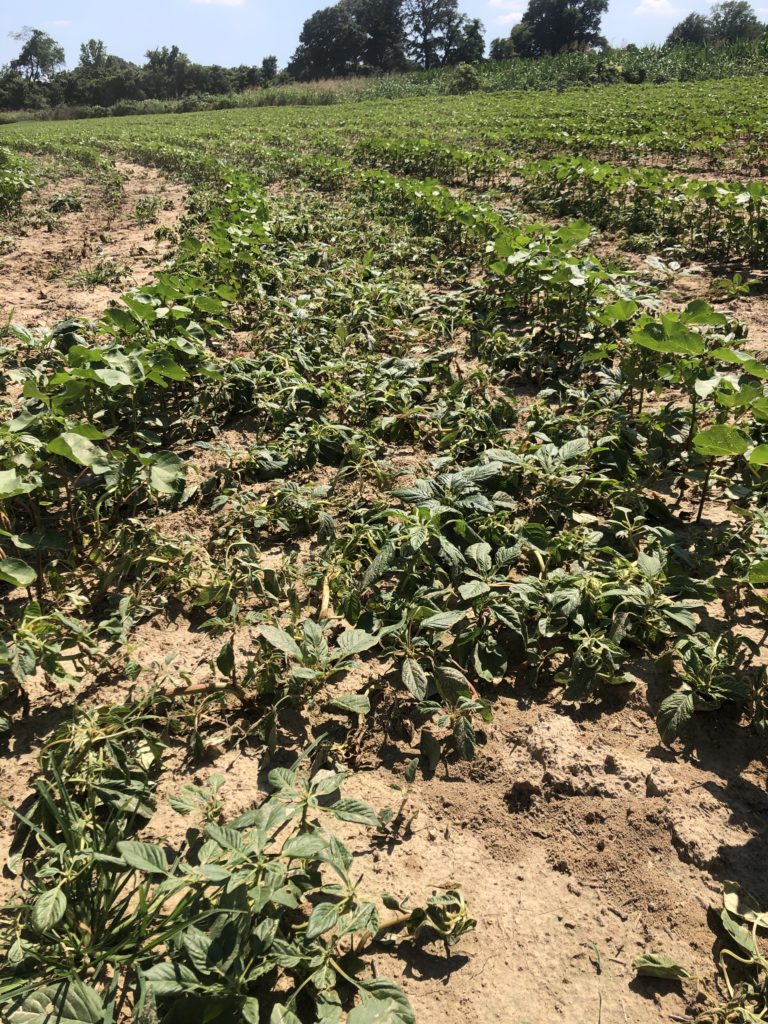
Palmer Amaranth Escaping 2 Applications of Engenia + Roundup PM. Crockett County TN. Pic taken 14 Days after 2nd Application

Calls continue to come in on concerns about poor Palmer amaranth control after a dicamba application. More than a few have reported that Palmer amaranth has survived multiple dicamba + glyphosate applications (Example above). Continue reading →