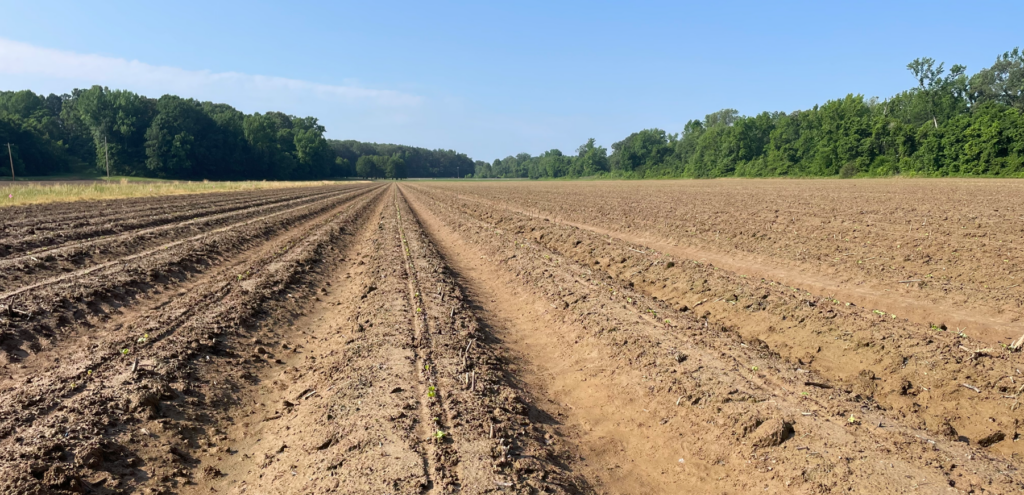
Although many in the state have finished planting, several are touching up wet spots or the occasional drowned out field. Unfortunately, others have seemed to catch two-fold the rainfall of the rest of the state and still have a large amount of ground to cover before they’ll near completion. In this article, I briefly discuss several important factors to consider during the replant or late plant scenario and provide a little data on yield potential by plant date. Continue reading →
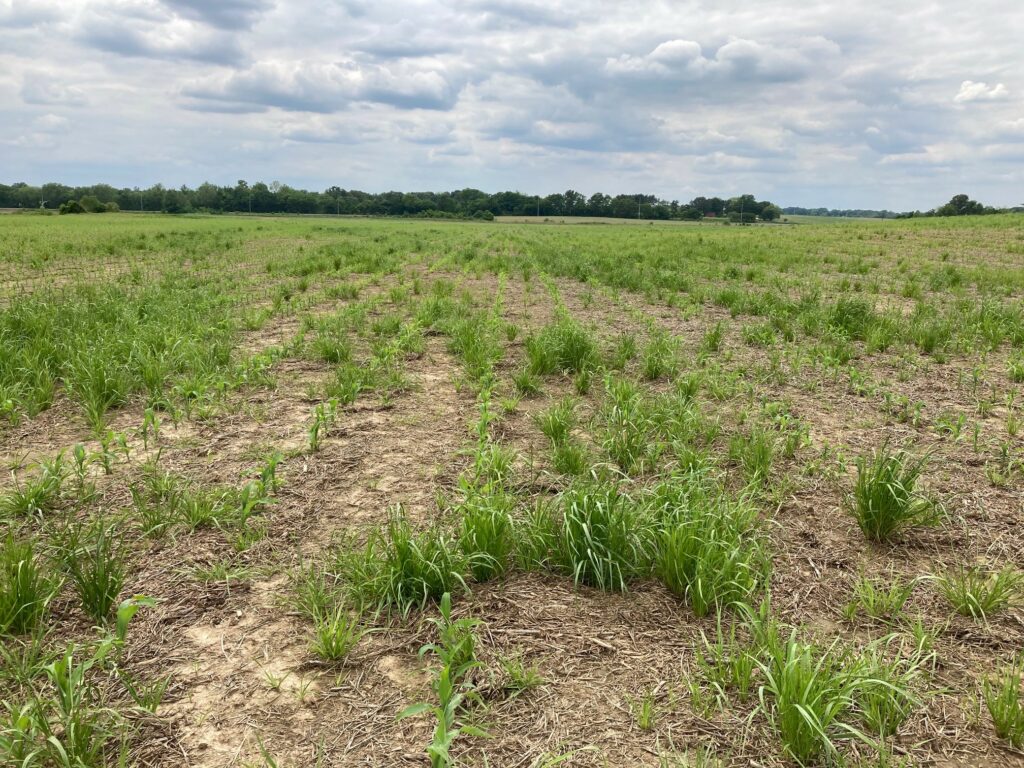
Ryegrass infestations still persist in some fields. In cotton and soybeans, clethodim can be used now to push this weed on to maturity. In corn, other than just going out and spraying the typical POST corn premix and hoping that pushes the ryegrass on to maturity there is no real solution to controlling it. Continue reading →
With warm conditions moving into West TN, many producers are well underway with cotton planting. Below are a few things to consider with regards to thrips control.
ThryvOn: ThryvOn is Bayer’s new Bt technology that has activity on thrips and plant bugs. ThryvOn cotton varieties are very effective against thrips and it is not anticipated that any fields will need foliar treatments. ThryvOn will still have thrips present (adults and immatures) but insecticide applications should not be triggered on thrips numbers but damage level (Fig 1.). Applications should be initiated when plant damage is approaching 3 in figure 1. That being said, I’ve evaluated ThryvOn varieties for several years under excellent and terrible growing conditions and I as well as my colleagues across the cotton belt, have never recommended a foliar spray for thrips.
Thrips Damage Ratings (D. Cook MSU)
Insecticide Seed Treatments (ISTs): ISTs are the predominate control method for thrips in cotton. IST performance can be highly variable depending on weather conditions and thrips pressure. High thrips pressure and poor growing conditions will often necessitate the use of foliar sprays even with ISTs. Seed treatment packages typically come in a base (storage rate of imidacloprid + fungicide) and field rates of imidacloprid (these have several names) + fungicides, others may have nematicides, biologicals etc. Base treated seed may as well have no insecticide, the small stored product rate will offer almost no control of insects in the field. Standard options of imidacloprid (0.375 mg ai/seed) are the minimum needed for insect control in field cotton.
In-furrow: In-furrow liquid applications of imidacloprid are more effective than seed treatments; however, resistance development to neonicotinoids are diminishing the efficacy of imidacloprid in-furrow. Fields with in-furrow imidacloprid may still require a foliar spray under heavy thrips pressure. Granular AgLogic (aldicarb 15G) is highly effective against thrips populations and works like aldicarb should.
Foliar Spray Options: My recommendations are going to be limited for foliar sprays. Based on ongoing tobacco thrips resistance monitoring, to organophosphates (OPs), started by Scott Stewart several years ago, I am hesitant to recommend Orthene or Bidrin for thrips sprays. Resistance levels, in assayed populations from West TN, and the number of complaint calls I received last year are a good indication that OPs have limited use against our tobacco thrips populations. There may be areas where OP’s worked last year but it’s hard to say if they will work this year. That being said, Intrepid Edge at 3.0 fl oz/a is my go to for foliar thrips control. Although more expensive than the OPs, Intrepid Edge runs no risk of flaring mites or aphids and a surfactant has shown to increase efficacy (herbicide surfactants will work if you’re co-applying). Recolonization vs failure is another subject with foliar sprays. Presence of adults doesn’t mean the application didn’t work, adult thrips are always present on seedling cotton. Presence of immature thrips means adults are feeding and laying eggs and whatever control method you used is broken.
I am big believer in NCSU’s thrips predictor model https://products.climate.ncsu.edu/ag/cottontip/. We utilize the model to target planting when thrips numbers are highest, growers would do the opposite. Model runs for locations around West TN show that cotton planted May 1st through the 15th have a low to very low probability of experiencing large thrips populations. This is hopefully a welcome relief from years of cold, wet springs with large thrips populations plaguing our cotton. The warm, dryish weather will help germinate cotton quicker and standard ISTs may be enough to push us to the 4 true leaf stage (when thrips are typically no longer a concern) without a foliar spray.
Picture 1. Palmer amaranth and goosegrass that emerged at 1 to 2 lf cotton and then escaped Post Application of Engenia + Glyphosate fb/Liberty + Glyphosate. Picture August 2022. Madison County TN
My understanding is that some cotton planted this year will contain the ThryvOn trait. According to UT entomologist Sebe Brown these varieties will likely not require any POST foliar insecticide application for thrips. This is great as far as management for that pest but from a weed management perspective this could be a problem. Continue reading →
The UT Cotton Scout School is scheduled for the last Friday of the month, May 26th, at the West Tennessee Research and Education Center (605 Airways Blvd, Jackson). There is no fee, and preregistration is not required. Registration begins at 8:00 AM with the program starting at 8:30. Content will include classroom and hands-on training with an optional go-to-the-field session after lunch. Topics covered will include cotton development and identification and symptoms of insect pests, plant diseases, and weeds.
This time of year as we move to burndown behind the planter we typically get some reports of mixing issues when either glyphosate or Gramoxone is added to the tank with residual herbicides like atrazine, metribuzin, Cotoran, Caparol, fomesafen or a pyroxasulfone containing product. What happens is the white herbicides will often clabber up and stop up screens and strainers in the sprayer. Continue reading →
Yet another cold snap moved through the area this past weekend and several had questions concerning the possibility of this event to damage our wheat crop. I’ve pasted a copy of the NOAA observed low temperatures throughout most of Tennessee’s wheat producing areas, and as you can see from the image temperatures fell very close to dangerous levels. Additionally, frost was reported in several areas. Continue reading →
With the planting season started, many people are thinking about using Gramoxone (paraquat) as a burndown for many weeds present at planting. Gramoxone is a very good broad-spectrum herbicide that has been the go to for burndown of many winter and summer annual broadleaf weeds. With Palmer amaranth starting to emerge, Gramoxone is the only sure thing that will control it. However, it is less consistent controlling some weeds like horseweed (marestail). Continue reading →




 Yet another cold snap moved through the area this past weekend and several had questions concerning the possibility of this event to damage our wheat crop. I’ve pasted a copy of the NOAA observed low temperatures throughout most of Tennessee’s wheat producing areas, and as you can see from the image temperatures fell very close to dangerous levels. Additionally, frost was reported in several areas.