
POP-UP SHOWERS DO LITTLE TO HINDER FIELDWORK
Hay baling was the dominant activity across the state last week with pop-up showers doing little to slow the second or third cuttings of hay. Other activities included spraying of fungicides on soybeans and the topping of tobacco. Pastures continued to look good due to the rainfall received over the past few months, but the elevated heat and humidity seen by most of the state placed a great deal of stress on livestock. There were 5.0 days suitable for field work. Topsoil moisture was rated 1 percent very short, 14 percent short, 77 percent adequate, and 8 percent surplus. Subsoil moisture was rated 1 percent very short, 13 percent short, 74 percent adequate, and 12 percent surplus. You can read the entire report here: TN Crop Weather 08_12_19. The USDA also realeased an updated crop condition report that can be viewed here: US Crop Progress 08_12_2019.


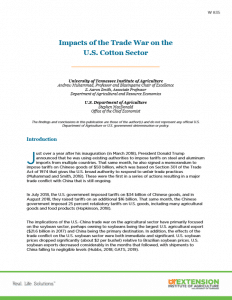 Dr. Andrew Muhammad and Dr. Aaron Smith published an Extension article earlier this week entitled “Impacts of the Trade War on the U.S. Cotton Sector.” I found the article to be extremely informative and while we typically focus on production issues, felt it was appropriate to share here. You can access the publication by clicking the image or following this hyperlink: https://extension.tennessee.edu/publications/Documents/W835.pdf

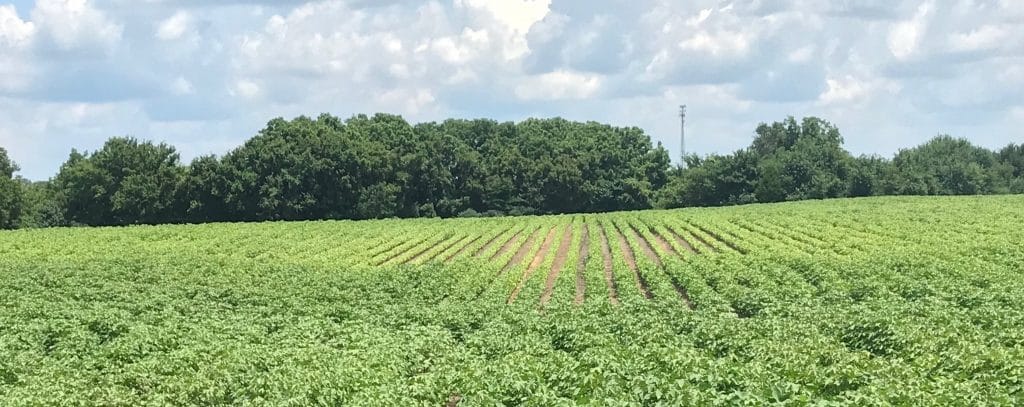 Over the past month, I’ve received several images of sulfur deficiencies in cotton. While we are quickly approaching a point in which a sulfur fertilizer application will be unable to impact yield in 2019, understanding what a sulfur deficiency looks like may help identify areas which will likely respond to the nutrient during the 2020 season. This blog covers the characteristics of a sulfur deficiency, presents atmospheric deposition data, and highlights current UT recommendations for the nutrient in cotton production.