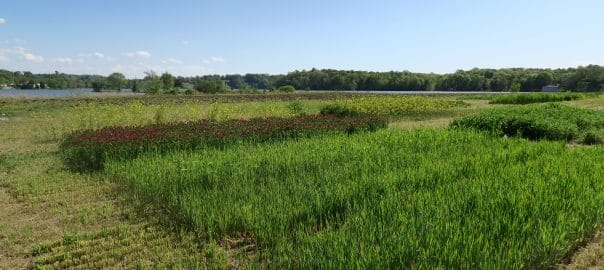
Our 2019 Tennessee corn silage hybrid trial report is now available on search.utcrops.com/corn-silage. We had fewer hybrids than usual this year and all produced similar yields, averaging 8.4 tons/ac dry weight. Differences did show in terms of quality, however, with some hybrids producing significantly higher milk/ton. Mean separation (MS) values help us identify statistical differences between hybrids. Look for the “A” group to identify hybrids that were top performers within each trait. If looking at the online tables, be sure to scroll right to see all of the quality and agronomic traits evaluated. Online tables can be found here or download the pdf and/or excel tables.

Recent Updates
Call of the Week: 2019/20 Cover Crop
In this podcast, Dr. Virginia Sykes discusses expectations for a short cover crop season, what species perform best under late planted conditions, and new cover crop varieties that are getting good marks in UT tests. Listen.
Call of the Week: Cotton Defoliation
In this podcast, Dr. Tyson Raper addresses cotton defoliation concerns and offers product recommendations for defoliating weather stressed plants. Listen.
Tennessee Weather and Crop Condition Update
TENNESSEE PERSISTS DESPITE DRY CONDITIONS
Corn harvest continues to progress rapidly with producers reporting favorable yields. Soybean growers with late-planted beans continue to feel effects of the extended hot, dry weather. Baling of hay continued to be a major activity due to near perfect harvesting conditions; some report concerns of quality. Pasture conditions continued to deteriorate as soil moisture decreased, causing worries among livestock producers. Some indicate that the need to feed hay is approaching; creating concern about stock levels through the winter. There were 6.8 days suitable for field work. Topsoil moisture was rated 25 percent very short, 50 percent short, and 25 percent adequate. Subsoil moisture was rated 19 percent very short, 48 percent short, and 33 percent adequate. The entire report can be read here: TN Crop Weather 09_13_2019. The latest National Crop Progress report can be viewed here as well: US Crop Progress 09_13_2019.
Cover Crop Species Selection for Tennessee Corn and Soybean Systems
In Tennessee, corn harvest is beginning and soybeans will be right around the corner. Time to start talking about cover crops, in particular, what options are best for your cropping system. Cover crops offer many benefits to cash crop systems, including weed suppression, nutrient credits, improved soil health, pollinator habitat, and more. Many species can be used as cover crops but each differs in the ecological benefits it can provide to a system as well as in its adaptation to production regions in Tennessee. This adaption is highly dependent on management practices, especially time of planting. A species selected as a top performer when planted after corn may not do so well in a system following soybeans, where cover crop planting is two to four weeks later. Planting a poorly adapted species reduces your return on investment in a cover cropping system, so let’s talk about what works in Tennessee. Continue reading
Tennessee Crop Weather and Condition Update
DRY WEATHER CAUSES CONCERN
Corn harvest was in full swing with producers generally reporting good yields. However, soybean growers, particularly those with late-planted beans, were concerned about the effects of the recent hot, dry weather. Baling of hay continued to be a major activity due to near perfect harvesting conditions. Hemp growers noted some disease pressure, but this did not appear to be affecting yields. Pasture conditions deteriorated rapidly as soil moisture decreased, causing worries among livestock producers. There were 6.9 days suitable for field work. Topsoil moisture was rated 11 percent very short, 41 percent short, 47 percent adequate, and 1 percent surplus. Subsoil moisture was rated 9 percent very short, 36 percent short, and 55 percent adequate. You can read the entire report here: TN Crop Weather 09_09_2019. You can also read the latest USDA national crop progress report here: US Crop Progress 09_09_2019.
Some considerations for soybean harvest aids
While the majority of soybeans are harvested without the benefit of a harvest aid, there are a few situations where they make sense. Using the right product in the right field at the right timing is key to achieving enhanced dry down without impacting seed quality. Continue reading