In 2017 and now again in 2018, the lack of horseweed (marestail) in many fields for late March is very notable. So what is the reason/s for the lower landscape level horseweed infestations? Continue reading


In 2017 and now again in 2018, the lack of horseweed (marestail) in many fields for late March is very notable. So what is the reason/s for the lower landscape level horseweed infestations? Continue reading
As of Monday we have had well over 2400 folks take the dicamba training in Tennessee. Our best estimate is that about 2500 total would be spraying Engenia or XtendiMax in Xtend crops so we are clearly in the short rows for getting applicators trained. If you still lack the dicamba training, contact your county Extension Agent.
Since most are now trained to apply dicamba, questions have arisen on strategies to manage Palmer amaranth in Xtend soybean under two different situations. Continue reading
A survey sponsored by the Tennessee Soybean Promotion was conducted last summer to determine the percentage of fields that harbored PPO-resistant Palmer amaranth in West Tennessee. We found that 83% of the fields tested had Palmer amaranth infestations that survived a field use rate of Flexstar (fomesafen). Recent field research has shown that these populations are also ALS & glyphosate-resistant.
Additionally, some of these multiple-resistant Palmer amaranth populations are proving to be difficult to control with a number of herbicides. So research was conducted to investigate the effectiveness of various herbicides in controlling PPO-resistant (Flexstar-resistant) Palmer amaranth compared to a location where PPO herbicides were still effective on Palmer. Continue reading
There are many more options to control horseweed (marestail) in soybean and cotton than what was available just a few years ago. The biggest new option for many acres of Xtend cotton or soybean has been the use of Engenia or XtendiMax closer to planting than the standard 21 days before planting use of Clarity. Continue reading
The 2018 Insect Control Recommendations for Field Crops (cotton, corn, soybean, wheat, sorghum, and pastures) can be found online on UTcrops.com. Insect and disease management recommendations for cotton and soybean are also available on the mobile-friendly Field Guide website at http://guide.utcrops.com/.
Suggestions: Add the UTcrops News Blog to your home screen for easy access to all these resources.
Dicamba training is well under way across the state. As of last week we have had over 1500 applicators who have taken the dicamba training. That should be about 60% of the total number of folks that will need to take this training. Please remember if you’re the operator of the sprayer you must go through the dicamba training. Moreover, in Tennessee you must also be a Certified Pesticide Applicator to apply dicamba.
It is clear to me that once again in 2018 Tennessee will plant a large majority of Xtend cotton. The change will be that the herbicide trait platform for soybean will move from roughly 60% Xtend in 2017 to greater than 80% Xtend this year.
My concern is that we have fields in this state where we have no business spraying any form of dicamba in June or July. These would be fields near high value crops like tobacco, vineyards, greenhouses and vegetable production. Continue reading
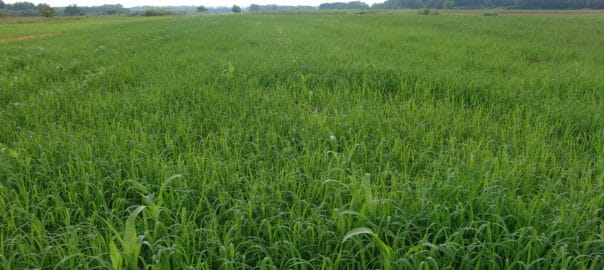
Barnyardgrass has been confirmed glyphosate-resistant in Tennessee. Field and greenhouse research conducted over the past few years strongly suggested glyphosate was no longer effective on barnyardgrass sourced from fields in some southwest Tennessee counties. Just in the last few month laboratory research conducted by USDA weed scientist Dr. Vijay Nandula at Stoneville, MS confirmed the mechanism of glyphosate-resistance (GR) as reduced translocation. Continue reading
Below are links to the presentations given at the 2018 Tennessee Grain Conferences and they can also be found at http://utcrops.com/presentations.htm.
2018 Tennessee Grain Conferences