Category Archives: Cotton

2019 Cotton Focus, Feb. 15th at WTREC

Author:  Comments Off on 2019 Cotton Focus, Feb. 15th at WTREC

2019 UT Cotton Focus event details and location.The 2019 UT Cotton Focus is only a few weeks away. This year’s meeting will be held at the West Tennessee Research and Education Center (605 Airways Blvd, Jackson, TN 38301) on Friday, February 15th.   Registration begins at 8:00 AM with opening remarks beginning at 8:25 AM.  This year’s event will feature a round-table on auxin herbicide stewardship and regulation as well as a general cotton specialists’ roundtable.  Additionally, UT Specialists will be presenting information on managing resistant bollworms, variety selection,  new diseases, and economic considerations for 2019, among other pertinent information.  We will also have an update on boll weevil eradication and a report from the National Cotton Council. The meeting will close with a provided lunch.  Pesticide re-certification and CCA points will be available. Look forward to seeing you there!


This Week in Dicamba Training…

Author:  Comments Off on This Week in Dicamba Training…

A slew of dicamba training opportunities are coming up over the next seven days.

  • Crockett Co. – Jan. 29 @ 2 p.m. – Gibson Electric Cooperative, Alamo
  • Gibson Co. – Jan. 28, 29 & 30 @ 9 a.m., 11 a.m. & 2 p.m. – UT Extension Office
  • Haywood Co. – Jan. 28 @ 10 a.m. – H & R Agri-Power, Brownsville
  • Lincoln Co. – Jan. 28 @ 1 p.m. – UT Extension Office
  • Montgomery Co. – Jan. 28 @ 4:30 p.m. – UT Extension Office
  • Tipton Co. – Jan. 29 @ 9 a.m. & Jan. 31 @ 2 p.m. – UT Extension Office

To see the complete list of 2019 trainings, visit the Dicamba Resources page.


Tennessee Market Highlights

Author:  Comments Off on Tennessee Market Highlights

Corn, cotton, and soybeans were up and wheat was down for the week.

Soybean prices continue to whipsaw based on news/speculation regarding three issues: 1) China-U.S. trade negotiations; 2) Brazilian weather – specifically dry conditions in the northeast; and 3) export sales (1 and 2 are driving 3). Availability of export data has been reduced due to the partial government shutdown leading to a greater divergence in export sales estimates. USDA reports can be viewed as a type of baseline line that provides market participants with a common estimate to base trading decisions on. This is not to say that the USDA estimates are correct or more accurate than estimates provided through other market sources, however the USDA estimates provide an equal starting point for market participants. Individual opinions, about the accuracy of the USDA’s estimates, will deviate substantially and allow traders to roll the dice one way or the other. Continue reading at Tennessee Market Highlights.


Tennessee Market Highlights

Author:  Comments Off on Tennessee Market Highlights

Corn and soybeans were down; cotton was mixed; and wheat was up for the week.

The partial government shutdown has resulted in several key reports (WASDE, Crop Production, and Grain Stocks being delayed. Reports will be released, however the USDA will determine the release schedule after the government resumes normal operations. An addition consequence of the partial shutdown is the inability for producers to complete paper work at FSA for Market Facilitation Program (MFP) payments. The payments were provided to producers to help mitigate the impact of retaliatory tariffs on commodity prices. The application dead-line was initially set as January 15, 2019, however USDA Secretary of Agriculture Sonny Perdue extended the deadline indicating: “We will therefore extend the application deadline for a period of time equal to the number of business days FSA offices were closed, once the government shutdown ends…”. This should allow producers time to complete the required paper work to obtain payments for 2018 production. Continue reading at Tennessee Market Highlights.


Enlist Soybean Gains China Approval: Some Thoughts

Author:  Comments Off on Enlist Soybean Gains China Approval: Some Thoughts

The news this week was the China approval of Enlist E3 soybeans (soybeans tolerant to glufosinate, glyphosate and 2,4-D) for import.  China also approved the import of Syngenta’s MGI soybeans.  Those soybeans are tolerant to Callisto, glufosinate and Balance herbicides. My understanding is this MGI trait in soybeans still needs EU approval so unlike the Enlist E3 soybeans they will not be offered for sale this year. Continue reading →


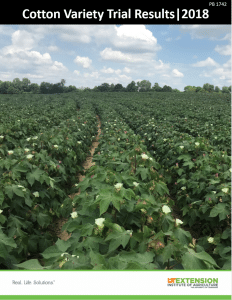
2018 TN Cotton Variety Trial Results now available (PB1742)

Author: and  Comments Off on 2018 TN Cotton Variety Trial Results now available (PB1742)
2018 Cotton variety trial results field.The 2018 TN Cotton Variety Trial Results Publication (PB1742) is now available online. This document contains detailed results from all harvested trails in the 2018 University of Tennessee Cotton Variety Testing Program.  This expanded publication follows the recently published summary publication, the 2019 TN Cotton Variety Guide (W285) which was released a few weeks ago.


The tech-trait diversity in the top performers again highlights the excellent yield potential, stability and fiber quality currently available in commercial cultivars regardless of tech platform. Trial results reported from the 2018 season include 58 varieties entered into 7 Official Variety Trials (OVTs) and 18 varieties entered into 10 County Standard Trials (CSTs).  Both OVTs and CSTs were scattered throughout TN’s cotton producing counties.  Additionally, in-season plant measurements and multi-year yield averages were reported for the OVTs.

We will be releasing results from a June planted OVT later this winter, so keep an eye out for those results on this blog.

Special thanks to all those who participated and/or contributed to the program during the 2018 growing season, and look forward to seeing many of you during our 2019 meetings.


Tennessee Market Highlights

Author:  Comments Off on Tennessee Market Highlights

Corn, cotton, soybeans, and wheat were up for the week.

2018 was an eventful year in corn, cotton, soybean, and wheat markets.
Trade, domestic policy, global economic growth, large yields, and poor harvest conditions all had substantial impacts on commodity prices. As always, supply and demand played an important role in commodity markets however, 2018 will likely be remembered for the many external influences – trade disruptions, Market Facilitation Program payments, a New Farm Bill, and government shut down to name a few – that inserted
tremendous volatility into commodity prices and producer profitability.

Looking out to the 2019 crop some price prospects have improved, compared to 2018, others have deteriorated. Last year at this time the new crop harvest contracts (2018 crop year) for the month of December (2017) averaged: $3.84/bu for corn; $9.91/bu for soybeans; 72.74 cents/lb for cotton; and $4.50/bu for wheat. In 2018, the new crop harvest contract (2019 crop year) for the month of December (2018) averaged: $4.01/bu for corn; $9.48/bu for soybeans; 76.25 cents/lb for cotton; and $5.34/bu for wheat. So the good news is corn, cotton and wheat were up 17 cents, 3.51 cents, and 84 cents (soybean prices were down 43 cents form a year ago). Continue reading at Tennessee Market Highlights.