All posts by Larry Steckel, Extension Weed Specialist

Technical Service Provider Training in Little Rock

As you know, we have been working with the Natural Resource Conservation Service (NRCS), and Tennessee Association of Conservation Districts (TACD) to develop a program to highlight the impact of herbicide resistant weeds on agriculture.  It appears that some cost share incentives will be offered to those farmers with “Herbicide Resistant Weed Management Plans”.

However, these plans must be written by qualified “Technical Service Providers” (TSPs) and since this is a new program, there are currently no TSPs to write the plans.  A training program has been pulled together over the past few days to offer TSP training to any consultant interested. Continue reading →


Corn Rotation on Fields with Heavy Glyphosate-Resistant Palmer Amaranth Seed Bank

What is the best herbicide for corn that is being planted into fields with overwhelming Palmer amaranth soil seed bank?  There are two key aspects to manage heavy GR Palmer infestations in corn.  First is to use at least two herbicides with good activity on Palmer amaranth.  The second is to use these herbicides in a split application. Continue reading →


Weed Control Considerations for Wheat

Author:  Comments Off on Weed Control Considerations for Wheat

Potential Herbicide Carryover Needs to be Considered before Planting Wheat. It was not uncommon last year for fomesafen (Flexstar, Rhythm, Dawn, Prefix and Reflex) applications in mid-summer to carry in and injure wheat. According to the label, four months must pass between a fomesafen  application and planting wheat this fall. The highest probability of carryover is in fields that have seen little rain this summer. This is another ramification of managing glyphosate resistant Palmer amaranth. 

Volunteer Roundup Ready Corn Management. There have been several calls about burning down volunteer Roundup Ready corn before wheat planting. In our research there have only been two herbicide applications that controlled the volunteer corn. One was 40- 48 oz/A of Gramoxone Inteon applied with 0.25% NIS at 15 gal/A. Coverage and rate are critical to make this work. The other option was to use 0.5 oz/A of Finesse which also did a good job plus it provides residual control of ryegrass and many broadleaf weeds. Finesse has been used in Tennessee for about three years now and has for the most part worked well. Of course, like all pres, it works best when it receives a rain 7 to 10 days after application to activate it. However, if it does not get an activating rain the weed control can be inconsistent. One thing to remember is if Finesse is used, only STS soybeans can be planted for double crop in the summer. 

Bluegrass Control in Wheat. Continue reading →


Soybean field with healthy and diseased plants.

Not Enough Sprayers

Author:  Comments Off on Not Enough Sprayers
 
Soybean field with healthy and diseased plants.
Ignite over the top followed a day later with Gramoxone Inteon + Valor

It is apparent that we do not have the sprayer power in the state to keep up with all the demand.  Most of the pre applied herbicides in cotton and soybeans have played out and folks are scrambling to treat these fields for Palmer pigweed while at the same time trying to keep plant bugs beat back.  In some cases, they can tankmix an insecticide with the herbicide in cotton but often the timing does not work out. Most cotton fields have seen one to two Ignite applications applied over the top.  There have been some reports of Continue reading →


Cotton field with tall grass and broad leaves.

Monitor for Glyphosate-Resistant Goosegrass

Author:  Comments Off on Monitor for Glyphosate-Resistant Goosegrass
 
Cotton field with tall grass and broad leaves.
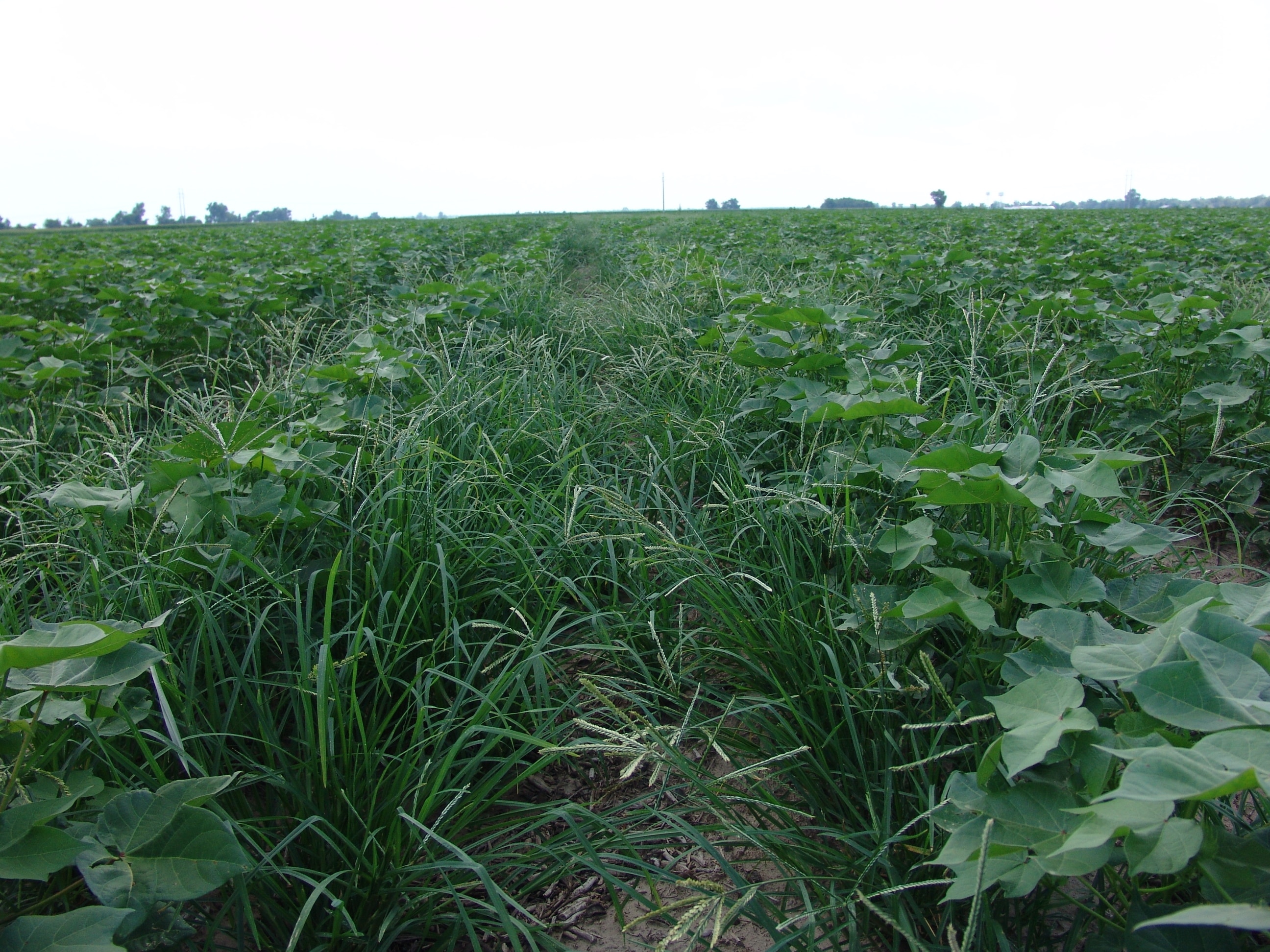
Glyphosate-Resistant Goosegrass after two 22 oz/A applications of Roundup PowerMax

Glyphosate-resistant (GR) goosegrass has shown up in a couple cotton fields in Lake and Dyer counties (picture left).  In these fields, repeated applications of glyphosate failed to control the goosegrass. Unfortunately, by the time the grower realizes that the grass is glyphosate resistant it has 4 or more tillers and is too large for even an application of Select Max or Fusilade to control.  Back in the late 1980s, Select Max or Fusilade did not control large goosegrass.  This appears to Continue reading →