All posts by Sebe Brown, IPM Extension Specialist

Fall Armyworms Appearing in Tennessee

Author:  Comments Off on Fall Armyworms Appearing in Tennessee

Over the past couple days, I’ve gotten a few reports of fall armyworms in pastures on the Mississippi/Alabama border with Tennessee. Tennessee will still have armyworms that migrate North and infest pastures, food plots and the occasional yard every year.  However, the wormageddon that happened in 2021 was a very unique event and will not occur yearly.
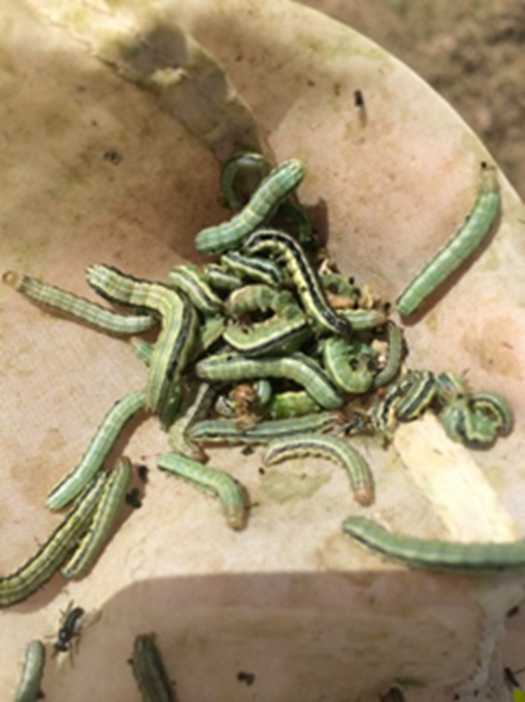
Fall Armyworms in Sweep a Net
Fall Armyworms in a Sweep Net

Fall armyworms don’t overwinter in Tennessee and populations migrate North from Texas and Florida every year. The difference in 2021 vs 2022-23 is the conditions that were occurring in April and May in South Texas. Texas experienced a warm and unseasonably wet spring that allowed for the proliferation of extremely large numbers of armyworms. Large numbers of moths plus ample food supply in pasture grasses, fallow grasses, yards and pretty much anywhere that had grass allowed this “army” to make its way North. Texas experienced outbreaks first followed by Louisiana, Arkansas, Mississippi then Tennessee with the moth flight culminating, in Canada, in November. I ask my colleagues, in Southern states, weekly if they are seeing any armyworms or anything resembling what happened in 2021 and the answer has consistently been no. My colleague, Dr. Nick Bateman, is getting calls about armyworms in rice but nothing even close to what was experienced in 2021.

If you do see armyworms it shouldn’t be automatically assumed that pyrethroids won’t be effective. We don’t fully understand why pyrethroids provided inconsistent control in 2021. Resistance is a possibility but overlapping generations causing mixing of various worm sizes resulting the appearance of poor control is another possibility. Also, since armyworms don’t overwinter in Tennessee and there is no evidence of reverse migration, the armyworms we experienced in 2021 won’t be the same ones we see in subsequent years. However, if pyrethroids do fail to control armyworms please contact your local county agent.

Going forward, pasture treatments should be considered when armyworm populations exceed 3 to 4 worms per square foot. If fields are ready or near ready for cutting, harvesting is suggested rather than applying an insecticide. Producers may watch for the presence of birds in a field as an indicator of armyworms. This method should not be the only one used to check for armyworms because this indication often is too late to avoid field injury. Early signs of infestations by small larvae cause plants to have a “window-paned” appearance. This is due to the larvae’s inability, at small sizes, to chew completely through the leaf blade leaving the upper epidermis intact. Large areas of window panning will give fields a frosted appearance. Ideally, scouting should be initiated in late July to early August without the presence of birds or frosted patches appearing so infestations can be caught early. When scouting during times when armyworms are not feeding (midday) be sure to dig through the thatch layer and check the base of plants. Detection of frass (insect excrement) is also a sign that armyworms may be present in a field.

Information on grazing restrictions, application rates and insecticide choice can be found below. https://extension.tennessee.edu/publications/Documents/PB1768.pdf

One final note to homeowners, don’t fall for armyworm preventative lawn treatments. Most lawn products that are utilized for fall armyworm outbreaks, especially foliar sprays, have limited residual efficacy and shouldn’t be applied if armyworms aren’t present. Insecticide residual, even in systemic products, grows out with your grass. If you mow your lawn on a regular basis the residual needed to control armyworms is mowed off and new growth may not be protected. Applying an insecticide for an insect that isn’t there or may never show up, isn’t IPM and is a waste of money. Your county agent is an excellent resource for information pertaining to armyworm control in home lawns and pastures and won’t try to sell you anything.


July 26 Bollworm/Budworm Catches for West TN

Author:  Comments Off on July 26 Bollworm/Budworm Catches for West TN
Location CEW TBW
Hardeman (Bolivar) 5 0
Fayette (Whiteville) 45 0
Fayette (Somerville) 2 0
Shelby (Millington) 22 0
Tipton (Covington) 3 0
Tipton (North) 26 0
Lauderdale (Golddust) 20 0
Haywood(West) 32 1
Haywood (Brownsville) 19 3
Madison (WTREC) 13 0
Madison (North) 0 0
Crockett (Alamo) 0 2
Crockett (Friendship) 14 0
Dyer (King Rd) 5 1
Dyer (Dyersburg) 34 1
Lake (Ridgely) 21 4
Gibson (Trenton) 26 0
Gibson (Milan Rec) 1 0
Carroll (Coleman Farm) 1 0

July 20 Bollworm/Budworm Catches for West TN

Author:  Comments Off on July 20 Bollworm/Budworm Catches for West TN
Location CEW TBW
Hardeman (Bolivar) 1 0
Fayette (Whiteville) 15 0
Fayette (Somerville) 18 0
Shelby (Millington) 21 0
Tipton (Covington) 2 0
Tipton (North) 19 0
Lauderdale (Golddust) 2 0
Haywood(West) 19 0
Haywood (Brownsville) 32 0
Madison (WTREC) 16 0
Madison (North) 0 0
Crockett (Alamo) 0 0
Crockett (Friendship) 6 0
Dyer (King Rd) 9 2
Dyer (Dyersburg) 46 0
Lake (Ridgely) 20 0
Gibson (Trenton) 0 0
Gibson (Milan Rec) 0 0
Carroll (Coleman Farm) 0 0

Middle Tennessee Soybean Scout School

UT Soybean Scout Schools

Author:  Comments Off on UT Soybean Scout Schools

UT’s Soybean Scout Schools will be held in July (see details below). These field-side programs cover the basics of soybean growth, scouting, pest identification, and general management. Three Pesticide recertification and CCA CEU points will be available. Scout Schools are offered free of charge with sponsorship from the Tennessee Soybean Promotion Board. Registration is not required. Participants will receive a scouting notebook and a sweep net while supplies last.

 West TN – Madison County, July 17th, 9:00 AM – 11:30 AM. This school will be at the West TN Research and Education Center, 605 Airways Blvd. Jackson TN, 38301. Signs will be up at the station to direct you to the field.

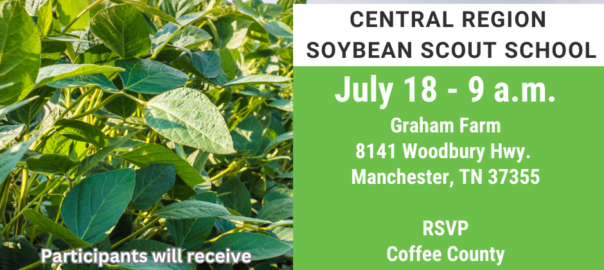
Middle Tennessee Soybean Scout School

Middle TN – Coffee County, July 18th, 9:00 AM – 11:30 AM. This school will be at Graham Farms,8141 Woodbury Hwy., Manchester, TN. Please contact Amy Willis Prince of the UT Coffee County Extension Office at 931-723-5141 or awillis2@utk.edu if you plan to attend.


East Tennessee Soybean Scout School

East TN –  Monroe County, July 19th, 9:00 AM – 11:30 AM. This school will be held at the  Monroe County Farm Bureau Office 501 Main Street, Madisonville, TN 37354.  Lunch will be provided. A head count is required for the meal, please contact Jonathan Rhea of the UT Monroe County Extension Office at 423-442-2433 or jrhea@utk.edu if you plan to attend.


Spider Mite Numbers Increasing in Cotton

Author:  Comments Off on Spider Mite Numbers Increasing in Cotton

I’ve received several phone calls about spider mites increasing in cotton around West Tennessee. Spider mites favor hot, dry weather and will often become an issue after plant bug applications are initiated. UT recommends treatment when 30-50% of plants are showing signs of injury and spider mites are still present.  Treatment options are fairly limited and most are mite specific. Abamectin based products are typically the first option because they are economical and effective. There are a couple different formulations of abamectin that are different lb/ai per gallon products.  Below is a rate conversion of 0.15 lb ai/gallon formulations (Willowood Abamectin 0.15 EC, etc)  to 0.7 lb ai/gallon formulations (Agri-mek SC 0.7, Willowood 0.7 SC, etc).

5.0 fl oz/a = 1.0 fl oz/a

7.0 fl oz/a = 1.5 fl oz/a 

8.0 fl oz/a =1.75 fl oz/a

10.0 fl oz/a = 2.0 fl oz/a

Abamectin rates below 7.0 fl oz/a or 1.5 fl oz/a should be avoided due to potential resistance issues and the increased likely hood of retreatment.

Other mite products such as etoxazole (Zeal, Stifle) are mite growth regulators that work very well but are more expensive and somewhat slower than traditional miticides.  Fenpyroximate (Portal) is a contact miticide that has a shorter residual than abamectin or etoxazole but works very well. Bifenthrin alone is not an adequate miticide and should be avoided.

Products used for controlling plant bugs, bollworms and stink bugs (OPs, pyrethroids) exacerbate mite populations and their use, especially during hot dry conditions, should be delayed until after bloom if possible. Mite populations can rebound quickly after miticide applications so diligent scouting is critical to slowing the spread of mites across a field.

One final note, I’ve received a few questions/observations of spider mites appearing to be worse in ThryvOn vs non-ThryvOn cotton. Based on what we know about the repellency or reduction of colonization of Western flower thrips and Tobacco thrips in ThryvOn varieties, it is very plausible that spider mites could appear sooner and be more severe in ThryvOn cotton. Adult and immature thrips are spider mite predators and can help keep mite infestations in check under optimum conditions. ThryvOn’s Bt trait reduces thrips numbers season long and may increase the likelihood of spider mite flare ups as the summer progresses. Keep a close eye on your cotton, especially ThryvOn for mites. 


Tarnished Plant Bug Migration into Cotton

Author:  Comments Off on Tarnished Plant Bug Migration into Cotton
TPB Adult
TPB Adult

I’ve received several calls on adult tarnished plant bug migration into ThryvOn cotton. Silking corn, blooming soybeans and flowering pigweed all contribute to large increases in plant bug numbers that make their way to cotton. ThryvOn’s bt gene can help reduce the amount of injury plant bugs inflict to squaring cotton but adults, especially large numbers of adults, can knock squares off of ThryvOn just like non-ThryvOn. I’ve seen ThryvOn cotton go from 90 plus percent square retention to sub 50 percent in 5 days due a large, consistent migration of adult plant bugs. The biggest benefit we see from ThryvOn is the reduction of plant bug immatures in bloom. That being said, you will typically see increased square retention in ThryvOn vs non-ThryvOn throughout the fruiting period. Scout your cotton and don’t ignore migrating plant bugs in ThryvOn or non-ThryvOn.

Insecticide performance thus far is pretty standard for pre-bloom cotton. 2.0 oz/a of Centric is performing well on plant bug populations 2 to 3x above threshold on the station and in the field. Although the same class of chemistry, imidacloprid’s performance is fair at best and recolonization often happens quickly after an imidacloprid application. I try to not recommend consecutive applications of neonics due to efficacy falling off after the first shot. However, consecutive shots of neonics may be warranted for several reasons (cost, presence of mites, personal choice etc.) and on the second application I tend to increase rates of Centric to 2.5 oz/a especially if it was used previously. After the second application we’ve pretty much exhausted that chemistry. Other options are acephate, which carries a high risk of flaring mites and aphids especially in our current dry period, Vydate which is effective in killing plant bugs but has limited residual, roughly 36 hours. Bidrin  isn’t labelled for plant bugs between first square and bloom. Transform, which is very effective, but is expensive and many want to save those shots for bloom unless aphids are present and Diamond. Diamond’s activity is best utilized in the 3rd week of squaring to first bloom window, several studies at MSU and UT have shown the best ROI of 6.0 fl oz/a Diamond during that time period.

Final note, I’ve received a few questions on squaring cotton having poor square retention but very few or no plant bugs are found scouting. Adult plant bugs, especially at this time of year, will move in and out of cotton quickly. The abundance of alternative hosts facilitates movement in and out of cotton without colonization. The take home is since most are scouting once a week, it is prudent to be more aggressive with applications and not risk square retention falling below 80% if you’re close. Monitoring square retention is one of, if not, the best way to determine if early-season treatments are working. Migrating adults can give the impression of an insecticide failure, but maintaining good square retention is an good indication that treatments are working.


2023 UT Soybean Scout Schools

Author:  Comments Off on 2023 UT Soybean Scout Schools

UT’s Soybean Scout Schools will be held in July (see details below). These field-side programs cover the basics of soybean growth, scouting, pest identification, and general management. Pesticide recertification and CCA CEU points will be available. Scout Schools are offered free of charge with sponsorship from the Tennessee Soybean Promotion Board. Registration is not required. Participants will receive a scouting notebook and a sweep net while supplies last.

 West TN – Madison County, July 17th, 9:00 AM – 11:30 AM. This school will be at the West TN Research and Education Center, 605 Airways Blvd. Jackson TN, 38301. Signs will be up at the station to direct you to the field.

Middle TN – Coffee County, July 18th, 9:00 AM – 11:30 AM. This school will be at Graham Farms,8141 Woodbury Hwy., Manchester, TN. Please contact Amy Willis Prince of the UT Coffee County Extension Office at 931-723-5141 or awillis2@utk.edu if you plan to attend.

East TN –  Monroe County, July 19th, 9:00 AM – 11:30 AM. This school will be held in Madisonville, TN (the exact location is being finalized).  Lunch will be provided. A head count is required for the meal, please contact Jonathan Rhea of the UT Monroe County Extension Office at 423-442-2433 or jrhea@utk.edu if you plan to attend.


Thrips Resistance Update

Author:  Comments Off on Thrips Resistance Update

To date, we have sampled several tobacco thrips populations across the Midsouth and Southeast. Every population tested has come back highly resistant to orthene (30 to 40% mortality). Bidrin performed marginally better but assayed populations resulted in mortality levels below 55%. One population from the Missouri Bootheel exhibited 80% mortality to Bidrin. Spinetoram, the thrips active ingredient in Radiant/Intrepid Edge, is performing well with 100% mortality exhibited in all populations tested. Intrepid Edge + surfactant is also performing the best in our foliar tests across the Midsouth. Organophosphate insecticides (Orthene, Bidrin, Dimethoate) are performing poorly in my tests in West Tennessee, which is no surprise. Increased Orthene rates didn’t improve control and may exacerbate other pests such as spider mites and cotton aphids. Overall, I haven’t received the number of calls/complaints that we had last year on Orthene/Bidrin but we had better growing conditions this year vs last and some fields outran thrips. We are continuing to assay populations from the Midsouth and Southeast and I’ll update the blog as we obtain more results.

Seedlings in test tubes for laboratory research
Thrips bioassay