
As we approach the historical last effective bloom dates later this month, I thought it might be appropriate to look at Tennessee’s 2026, relative to the past ten years. In this blog, I briefly cover our season and make some comments on what to expect in the coming weeks.
An early start . . . for some
The 2026 season started earlier for most, with soy and corn planting wrapping-up for many well-in-advance of the typical finish. Although the early grain planting window also saw a cotton market run, our acre numbers didn’t respond much, largely since the cement was already poured, if not set, on our crop mix.
The warmer, drier window that opened for grain remained open for cotton and allowed more cotton to be planted in April than we’ve seen in recent memory. As you might expect, many of those stands were thin. A side note here- while uniformity is critical (we cannot compensate for large gaps in stands), I would argue that a very thin, yet uniform April stand with around 1.5 plants per row foot would be a stand to keep. Additionally, we must expect slow initial growth from plants placed in wet, cool conditions. Although many replanted some of their earliest planted cotton, I kept mine. I’d encourage anyone in the area to poke through my early planted Official Variety Trial here in Jackson; it is a solid testament to gritting your teeth and keeping thin, marginal, early-planted acres, even though a mid-May planting date often appears to have the vigor of a bean when emerging.
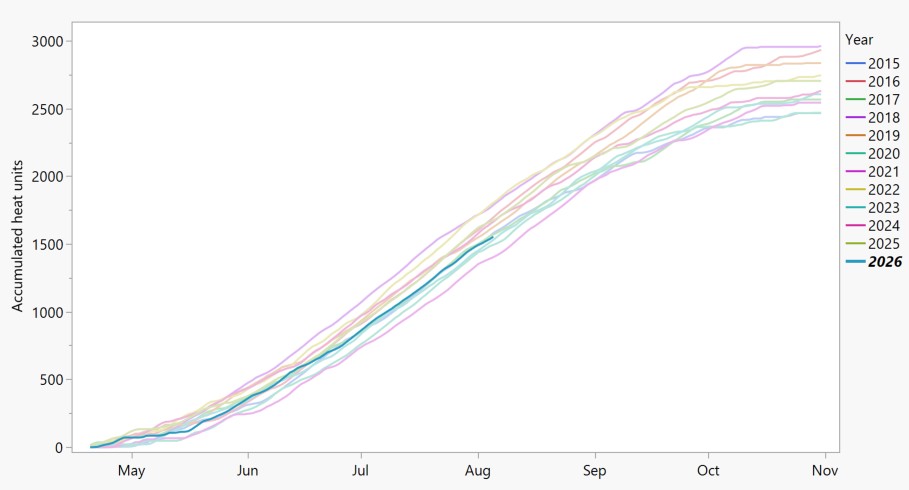
Mother nature made up for a warmer last couple of weeks of April with a slightly cooler first couple of weeks of May. That deviation can be seen in the heat unit accumulation curve; although we pushed ahead of the median initially, the cooler start to May pulled us well-below the average for accumulated heat units through the second week of May; in the past 10 years, only 2021 and 2020 reported fewer heat units accumulated by the 15th of May. However, from the 15th of May through the 1st of June, the 2026 season accumulated heat units at a fast enough pace to pull into what represents almost a perfect ‘average’ year, again, considering the past 10 years.
Mid season
The ‘average’ heat unit accumulation rate held from June 1st to July 28th. With the cool temperatures over the weekend, a very slight dip developed, relative to the other graphed years. Another side note here, on a common misconception- cotton does not need excessive heat during the summer. Dr. Derrick Oosterhuis, a world-renowned Cotton Physiologist who retired from the University of Arkansas several years ago, consistently defined the optimal diurnal range for cotton to be 68F to 86F. The real concern for us is not a lack of ‘heat’ through August and the first few weeks of September, but instead, an early start to fall in the last few weeks of September, and an erosion of temperatures as we move into October.
Will we reach physiological cutout or seasonal cutout first in 2026?
Many of our earliest planted acres are either flirting with, or have just reached, physiological cutout. The remainder (all but the latest planted acres) are still a few weeks out. I did a deep dive on physiological versus seasonal cutout a few years back, for those wanting to brush up on those concepts, I’d point you back to that blog from the 17th of August in 2022. Briefly, physiological cutout is the point in which reproductive growth overtakes vegetative growth. After physiological cutout, most of the white flowers which develop will likely not develop into harvestable bolls. We have historically considered this point to occur when there are only five nodes above the uppermost, first position white flower (NAWF). Recently, observations would suggest physiological cutout, in our modern cultivars, may be occurring at four or even three NAWF.
Seasonal cutout, in contrast, represents the point in which there are not enough heat units left in the season to support boll development. Many have attempted recently to redefine these dates- some of the most interesting efforts right now are coming out of Dr. Guy Collins’ program in North Carolina. Based on his research, the latest date in which a white flower has greater than a 50% chance of developing a boll may be much, much later now than we’ve previously considered.
Fortunately, the generally-reported exceptional retention levels and the early or on-time nature of most of our crop should allow us to reach physiological cutout in 2026 well in advance of seasonal cutout. However, on the latest planted acres, or acres which have seen very low levels of retention, I wouldn’t hesitate to protect flowers that open before 5 NAWF as late as the 1st of September.
What agronomic decisions remain?
The ‘shutdown’ PGR application. Should I do it?
Several have recently asked about the value of a late-season plant growth regulator application to increase yield and prevent the development of a ‘switch’ in otherwise well-managed cotton. I have not reviewed any data that supports the practice; while applying a PGR shot at this timing can limit internode length, it does not increase the amount of photosynthate pushed to reproductive structures instead of vegetative structures- and therefore will likely not pay for itself.
I’ve got leaf spots. Should I spray a foliar fungicide?
Leaf spots are showing up. All I have seen, up to this point, fall in the ‘leaf spot complex’-either Alternaria, Cercospera, or Stemphylium- and do not warrant an application of a foliar fungicide. Foliar fungicides targeting the ‘leaf spot complex’ do not increase yields and subsequently provide a negative return on investment. Even worse, applications at this timing often complicate defoliation.
This complex generally appears when the plant is scavenging for resources and either means we are going through some type of stress OR the plant is trying to concurrently mature many fruiting bodies. In 2026, the main reason we are seeing spots show at this timing is latter.
With that in mind, looking forward-
While I think it can be particularly helpful, in marginal years, to try to come up with a rough estimated yield number, I don’ t believe a hard number helps us much in a ‘good’ year. What I will say, here on the 6th of August, is I find it difficult to walk our ‘average’ acre without smiling.
